by agenna | Feb 18, 2026 | Anger
THE ANGER SERIES • PART 2 OF 5
Why Does Anger Feel So Good?
The neurochemistry behind the emotion your brain keeps choosing
By Coach Agenna | coachagenna.com
Reading time: 7–8 minutes
Let’s be honest about something nobody talks about.
Anger feels good.
Not in the way you’d say out loud. Not in the way you’d admit at a dinner party or a small group or a therapy session. But somewhere in your body—when someone crosses a line, when someone dismisses you, when something feels deeply unfair—anger rises up, and it feels like power.
It feels like clarity. Like you finally know exactly what to say. Like every ounce of confusion you’ve been carrying just got organized into one clean, burning emotion.
And for a moment, it works.
So why does anger feel so good? And if it feels good, why does it keep making your life worse?
Your Brain on Anger: Why Anger Feels Good
Here’s what’s actually happening in your body when anger shows up.
When your brain perceives a threat—real or imagined—your amygdala fires before your prefrontal cortex has time to evaluate the situation. This is the fight-or-flight response, and anger is the fight side of that equation.
Within milliseconds, your body releases a cocktail of neurochemicals:
Adrenaline surges, giving you energy and focus. Cortisol floods your system, keeping you on high alert. Norepinephrine sharpens your attention, narrowing your focus to the threat. And—here’s the part nobody tells you—your brain releases dopamine. The same chemical associated with reward, pleasure, and motivation.
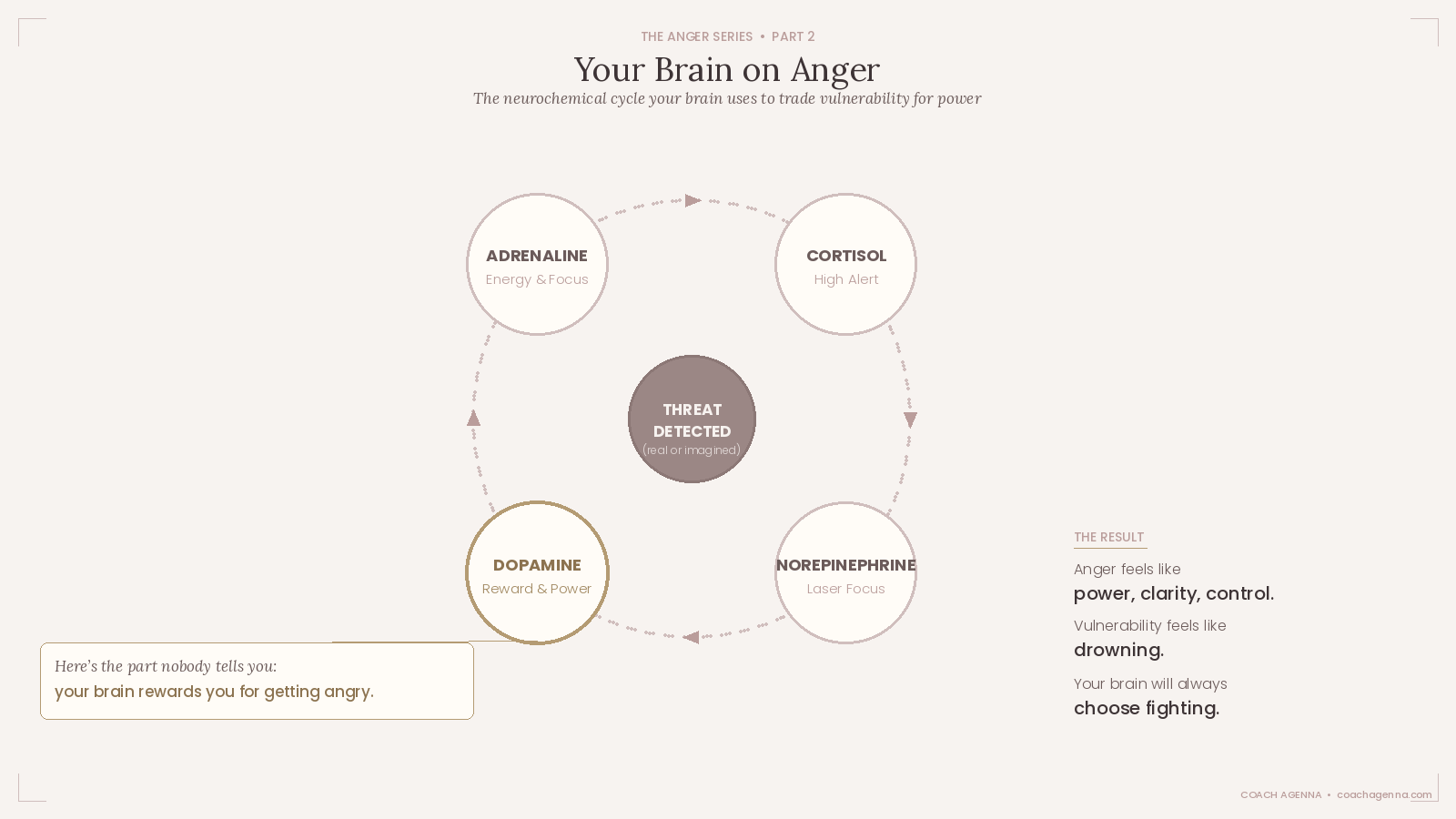
That’s right. Your brain rewards you for getting angry.
Not because anger is good for you. But because your brain is designed to protect you, and anger feels like protection. Your nervous system doesn’t know the difference between a grizzly bear and a dismissive comment from your spouse. It just knows something feels threatening, and anger is the fastest way to make you feel powerful enough to survive it.
The Trade Your Brain Is Making
In Part 1 of this series, we talked about anger as a secondary emotion—the bodyguard standing in front of the thing you’re actually feeling. Rejection. Inadequacy. Loneliness. Fear. Shame.
Now let’s go one step deeper.
Your brain isn’t just hiding those emotions behind anger. It’s actively trading them for anger. Because anger comes with a neurochemical payoff that vulnerability doesn’t.
Think about the last time you felt deeply rejected. What did that feel like in your body? Probably heaviness. Tightness in your chest. A sinking feeling. Maybe even nausea. Your body doesn’t know what to do with rejection. There’s no clear action step. Rejection just… sits there.
Now think about the last time you got angry instead. What happened? Your body surged. Your jaw tightened. Your thoughts sharpened. Suddenly you weren’t a person sitting with an unbearable feeling. You were a person with something to say, something to do, someone to confront.
That’s the trade. Vulnerability feels like drowning. Anger feels like fighting. And your brain will always choose fighting.
Why “Just Calm Down” Doesn’t Work
This is why anger management strategies that focus on calming down rarely produce lasting change. Deep breathing, counting to ten, walking away—these are useful in the moment. They regulate the nervous system. They buy you time.
But they don’t address the real question: What is your anger protecting you from feeling?
If you only manage the anger without exploring what’s underneath it, your brain will keep making the same trade. Every single time. Because the reward system is still intact. The dopamine hit is still waiting. And the vulnerability underneath is still too uncomfortable to sit with.
This is why people who are “good at controlling their anger” often describe themselves as exhausted. They’re spending enormous energy suppressing something their brain is actively incentivized to produce.
The Real Question Behind the Anger
So if anger feels good because it protects you from harder feelings, the path forward isn’t to get rid of anger. It’s to become a person who can tolerate the feelings anger is covering.
That is an entirely different kind of work.
It looks like sitting with discomfort long enough to name it. It looks like asking, “What am I actually afraid of right now?” when your fists are clenched. It looks like noticing that the fury you feel about a work email is actually grief about something much older and much more personal.
Sitting with discomfort is one of the bravest things a person can do. It’s not passive. It’s not weak. It’s the decision to feel the real thing instead of the easy thing.
What Anger Is Costing You
Here’s the part your brain won’t tell you while it’s handing you the dopamine:
Anger has a cost.
It costs you relationships—because people stop being honest with someone who might explode. It costs you intimacy—because vulnerability is the price of admission, and anger keeps you locked out. It costs you your health—chronic anger is linked to increased risk of cardiovascular disease, weakened immune function, and elevated cortisol levels that disrupt sleep, digestion, and mood regulation.
And perhaps most importantly, it costs you self-knowledge. Every time anger answers the door before you can get there, you miss the chance to understand what you’re actually feeling. Over time, you lose fluency in your own emotional language. You stop being able to identify what’s hurt from what’s threatening from what’s just uncomfortable.
Anger becomes the only tool in the box. And when all you have is a hammer, everything looks like a nail.
A Different Kind of Strength
There’s a lie embedded in the neurochemistry of anger, and it goes like this: Feeling powerful is the same as being strong.
It’s not.
Power surges and then crashes. Strength is sustainable. Power pushes people away. Strength draws them in. Power protects the surface. Strength heals what’s underneath.
The kind of strength I’m talking about doesn’t look dramatic. It looks like a person in the middle of a hard conversation who says, “I’m not angry. I’m hurt.” It looks like someone who takes a breath—not to suppress the anger, but to get curious about it.
It looks like someone who stops fighting the bodyguard and starts asking what it’s protecting.
What to Do With This
If you’re reading this and recognizing yourself, here are three things to try this week:
First, notice the surge. The next time anger shows up, pay attention to the moment right before. Not the anger itself—the split second before the anger. What was the first feeling? Was it embarrassment? Fear? Rejection? That first feeling is the real one. Anger is the cover story.
Second, name it out loud. Say it to yourself, to a journal, to someone you trust. “I’m not angry. I’m scared.” “I’m not angry. I feel dismissed.” Naming the real emotion interrupts the trade your brain is trying to make.
Third, sit with the discomfort for thirty seconds longer than you want to. You don’t have to resolve it. You don’t have to fix it. Just don’t let anger replace it. Thirty seconds of real feeling is more transformative than thirty minutes of managed fury.
Coming Next
In Part 3 of the Anger Series, we’re going deeper—into the inner critic. If anger is the bodyguard, your inner critic is the one who hired it. Every “should” and “not enough” traces back to a rulebook written by a kid who was just trying to survive.
We’ll talk about how to relieve your inner critic of duty—without destroying it.
If you’re tired of the anger cycle and ready to explore what’s underneath, coaching can help.
Book a free discovery call at coachagenna.com.
You shouldn’t have to keep choosing anger because it’s the only emotion that feels safe. With coaching, you won’t.
Want to go deeper with this series?
Download the free Anger Series Companion Guide — five weeks of journaling prompts, exercises, and awareness practices that walk you through everything the bodyguard is protecting.
THE ANGER SERIES
Part 1: Anger Is the Bodyguard, Not the Boss
Part 2: Why Does Anger Feel So Good? ← You are here
Part 3: Your Inner Critic and Anger
Part 4: Why Do I Keep Going Back to Anger?
Part 5: What Does the Bible Say About Anger?
FAQ
Q: Why does anger feel so good? A: Anger triggers a release of adrenaline, cortisol, norepinephrine, and dopamine. Your brain literally rewards you for getting angry because it interprets anger as a survival response. The result is a surge of energy, focus, and a false sense of control.
Q: Is anger a secondary emotion? A: Yes. Research in affective neuroscience shows that anger typically covers a more vulnerable primary emotion like fear, shame, rejection, or inadequacy. The brain trades the discomfort of vulnerability for the neurochemical payoff of anger.
Q: Why does anger management not work? A: Traditional anger management focuses on calming the anger response but doesn’t address the underlying emotions anger is protecting. Without exploring what’s underneath, the brain continues to default to anger because the reward system remains intact.
Q: How do I stop getting angry so easily? A: Start by noticing the feeling that comes right before anger. Name it out loud. Then practice sitting with that discomfort for thirty seconds longer than you want to. Over time, this builds your capacity to feel the real emotion instead of defaulting to anger.
by agenna | Feb 15, 2026 | Anger, Uncategorized
THE ANGER SERIES | PART 1 OF 5
Anger Is the Bodyguard, Not the Boss
Why your anger isn’t the problem—it’s the cover story.
Someone I love sat across from me recently and said something so honest it stopped the whole conversation.
“I’m trying to figure out the exact moment I got angry today. And part of me—part of me actually wants to be angry.”
Then he paused.
“But when I get past the anger, I realize how much better it is. So why do I keep going back to it?”
That question. Right there. That’s the one most people never ask. “So why do I keep going back? Why am I angry all the time?“
They stay in the anger. They justify it. They build a case for it. And they never get curious about what the anger is actually doing.
So let me tell you what I told him.
Anger Is a Secondary Emotion
Anger is not the thing. Anger is the thing that covers the thing.
Your brain is brilliant. When it senses a primary emotion that feels too vulnerable—rejection, loneliness, inadequacy, fear, or shame—it reaches for anger like a bodyguard stepping in front of a VIP. Anger feels powerful. Anger feels justified. Anger gives you something to do with the pain.
But anger is not the wound. It’s the armor.
The Gottman Institute, which has studied couples and emotional dynamics for over fifty years, calls this the Anger Iceberg. What people see on the surface—the raised voice, the sharp tone, the clenched jaw—is just the tip. Underneath the waterline, hidden from view, are the emotions anger is working overtime to protect: embarrassment, loneliness, exhaustion, fear, and shame.
And the reason your brain prefers anger? Because anger is easily justified. Think about it. When you’re angry, you can build an airtight case for why you have every right to feel the way you feel. You can point to the offense, the disrespect, and the injustice. You can make it about them.
But the primary emotion underneath? That’s about you. And that’s a much harder place to go.
Brené Brown, whose research on vulnerability and shame has shaped how we understand human emotion, puts it bluntly in Daring Greatly: anger “only serves as a socially acceptable mask for many of the more difficult underlying emotions we feel.” She says we’ve “confused feeling with failing and emotions with liabilities.”
That’s worth sitting with.
Your Brain on Anger
There’s a neuroscience reason this happens, and it’s not just metaphorical. Psychologist Daniel Goleman, in his groundbreaking book Emotional Intelligence, coined the term “amygdala hijack” to describe what happens when your brain’s emotional alarm system takes over before your rational mind can weigh in.
Here’s the short version: Your amygdala—a small, almond-shaped structure deep in your brain—is designed to detect threats. When it senses danger, it fires before your prefrontal cortex (the thinking, reasoning part of your brain) can even get online. Your heart rate spikes. Adrenaline floods your system. Your blood literally flows to your hands, preparing you to fight.
The problem? Your amygdala doesn’t know the difference between a physical threat and an emotional one. A dismissive comment from your spouse can trigger the same neurological cascade as a bear in the woods. And by the time your rational brain catches up, you’ve already said the thing, slammed the door, or shut down completely.
That’s not a character flaw. That’s biology. But understanding it gives you the power to interrupt it.
What If Anger Isn’t the Problem?
Most people treat anger like it’s the issue. They try to manage it, suppress it, or white-knuckle their way through it. But what if anger is actually a signal—a flashing light on your dashboard telling you something deeper needs attention?
What if the real question isn’t “Why am I so angry?” but “What discomfort am I not willing to sit with?”
That shift changes everything. Because now you’re not fighting the anger. You’re getting curious about it. You’re asking it what it’s protecting. And in my experience—both personally and as a coach—anger is almost always protecting one of these:
Rejection—the fear that you’re not wanted.
Inadequacy—the belief that you’re not enough.
Loneliness—the ache of being unseen.
Fear—the sense that something you value is at risk.
Shame—the story that says something is fundamentally wrong with you.
Every one of those is harder to feel than anger. Every one of those requires vulnerability. And vulnerability? That’s the last thing most of us want to offer when we’re already hurting.
Here’s What I Want You to Do
The next time anger shows up—and it will—don’t try to kill it. Don’t shame yourself for it. Instead, pause and ask:
What just happened right before I got angry?
What am I actually feeling underneath this?
What discomfort is this anger helping me avoid?
You don’t need to have the answer immediately. You just need to start asking. Because the moment you get curious about your anger instead of controlled by it, you take back the driver’s seat.
Goleman’s research shows it takes roughly six seconds for the stress chemicals from an amygdala hijack to begin to dissipate. Six seconds. That’s one deep breath. One pause. One choice to respond instead of react.
Start there.
Coming up in Part 2: We dig into what’s underneath the anger and why your brain would rather feel anything than sit with the real thing.
Want to go deeper with this series? Download the free Anger Series Companion Guide — five weeks of journaling prompts, exercises, and awareness practices that walk you through everything the bodyguard is protecting.
If this hit close to home, I’d love to help you go deeper. Coaching is where we take conversations like this and turn them into real, lasting change. You can learn more or book a free discovery call at coachagenna.com.
by agenna | Dec 18, 2025 | Uncategorized
Part 3 of the Christmas Survival Series for Trauma Survivors
You shouldn’t have to white-knuckle your way through Christmas dinner.
And with the right tools? You won’t.
Perhaps you’ve already decided to go. Maybe you have to go—for your kids, for a family member who needs you, for reasons that are yours alone. Maybe you read Part 1 (permission to skip) and Part 2 (your safety plan), and you’ve decided: I’m doing this.
This post is for you.
Because showing up is only half the battle. The other half is surviving what happens once you’re there—when your nervous system starts sounding alarms, when the room feels too small, when your abuser says something that sends you spinning.
You need tools you can use in the moment. Discreet. Effective. Practiced before you need them.
Let’s build your toolkit.
Recognizing When You’re Triggered
Before you can use coping tools, you have to recognize when you need them. And here’s the tricky part: sometimes you don’t realize you’re triggered until you’re deep in it.
Your body often knows before your brain does. Learn to read its signals.
Body Signals:
- Heart racing or pounding
- Chest tightening
- Stomach churning or dropping
- Hands shaking or sweating
- Feeling hot or flushed
- Feeling suddenly cold
- Muscles tensing (especially jaw, shoulders, fists)
- Shallow breathing or holding your breath
- Nausea
- Dizziness or lightheadedness
Mind Signals:
- Racing thoughts you can’t slow down
- Brain fog—can’t think clearly, can’t find words
- Feeling “far away” or like you’re watching yourself from outside
- Time feels strange (too fast, too slow)
- Sudden overwhelming emotion (rage, fear, despair)
- Going blank—mind emptying completely
- Intrusive memories or flashbacks
- Hypervigilance—scanning for danger, unable to relax
Behavioral Signals:
- Going quiet when you’re normally talkative
- Talking too fast or too much
- Laughing at things that aren’t funny
- Agreeing with everything to avoid conflict
- Freezing—unable to move or respond
- Wanting to run
- Picking at your skin, nails, or hair
- Clenching or unclenching your hands
The key is catching it early. The sooner you notice you’re activated, the more options you have. Once you’re in full-blown panic or dissociation, your tools are harder to access.
Check in with yourself regularly—every 30 minutes if you need to. Ask: How’s my body right now? What am I feeling?
The 5-4-3-2-1 Grounding Technique
This is your go-to tool for pulling yourself out of triggered brain and back into the present moment. It works because it forces your brain to engage with your actual surroundings instead of the threat it thinks it’s perceiving.
Here’s how it works:
Find 5 things you can SEE.
Look around the room. Name them silently or out loud if you can: the Christmas tree, the red tablecloth, Grandma’s painting, the window, the dog.
Find 4 things you can TOUCH (and actually touch them).
Feel the texture of your sweater. The smooth edge of your plate. The chair beneath you. Your own hands pressed together.
Find 3 things you can HEAR.
The music playing. Someone laughing in the other room. The heater humming. A car passing outside.
Find 2 things you can SMELL.
The food cooking. Pine from the tree. Your own perfume. Coffee.
Find 1 thing you can TASTE.
The mint you just had. Your drink. The lingering taste of dinner.
Pro tips:
- Practice this BEFORE Christmas. Do it at home, in your car, at the grocery store. The more familiar it is, the easier it is to access when you actually need it.
- You can do this silently, at the table, without anyone noticing.
- If you can’t find enough things in one category, just move to the next. Don’t get stuck.
- Go slowly. The point isn’t to rush through—it’s to really engage each sense.
The Time and Place Reminder
When you’re triggered, your brain often doesn’t know the difference between past and present. It thinks the danger is happening NOW. This grounding technique reminds your nervous system where and when you actually are.
Say to yourself (silently or whispered):
“My name is [your name]. I am [your age] years old. I am in [location]. It is [date/year]. I am safe right now.”
For example:
“My name is Sarah. I am 34 years old. I am in my parents’ living room in Ohio. It is December 25th, 2025. I am safe right now. I am an adult. I have my own car. I can leave whenever I want.”
Add details that emphasize your adult power and agency:
- “I have my own home.”
- “I have a job and my own money.”
- “I drove myself here.”
- “I can leave.”
- “I am not a child anymore.”
- “That was then. This is now.”
This is especially powerful for survivors whose trauma happened in childhood. Your nervous system may still respond as if you’re that child. Remind it: you’re not. You’re an adult with resources and options you didn’t have then.
Temperature Shock Techniques
Cold activates your vagus nerve and can snap your nervous system out of panic mode quickly. These are some of the most effective grounding tools available—and you can use them discreetly.
Cold water on wrists:
Run cold water over your inner wrists in the bathroom. Hold them there for 30-60 seconds. The wrists have pulse points close to the surface, so the cold travels quickly.
Cold water on face:
Splash cold water on your face, especially your forehead and cheeks. If you can, hold a cold wet paper towel against the back of your neck.
Ice cube in your hand:
If you can discreetly get an ice cube from a drink, hold it in your closed fist. Focus on the sensation—the cold, the melting, the slight discomfort. This is called “ice grounding” and it’s incredibly effective for dissociation.
Cold drink:
Hold a cold glass against your cheek or forehead. Take small sips and focus on the temperature going down your throat.
Step outside:
If it’s cold out, step onto the porch for a minute. Let the cold air hit your face. Take three deep breaths of cold air.
What you can bring:
- A small ice pack (the kind for lunches) in your pocket or purse
- A cold water bottle you keep nearby
- Cooling wipes or a damp washcloth in a zip-lock bag
Breathing Techniques You Can Do at the Table
Your breath is the one thing you always have access to—and it’s one of the fastest ways to calm your nervous system. These techniques are completely invisible to everyone around you.
Box Breathing (4-4-4-4):
- Breathe IN for 4 counts
- HOLD for 4 counts
- Breathe OUT for 4 counts
- HOLD for 4 counts
- Repeat 4 times
Extended Exhale:
- Breathe IN for 4 counts
- Breathe OUT for 6-8 counts
The longer exhale activates your parasympathetic nervous system (the “rest and digest” system). This tells your body the threat is over.
Belly Breathing:
Put one hand on your belly (under the table if needed). Breathe so your belly expands, not your chest. Chest breathing = stress. Belly breathing = calm.
The Sigh:
Take a deep breath in through your nose, then let it out through your mouth with an audible sigh. This is actually one of the fastest ways to reset your nervous system. Do it once or twice—it looks completely natural, like you’re just tired.
The Bathroom: Your Escape Room
The bathroom is your sanctuary. It’s the one place you can go without explanation, lock the door, and have a few minutes completely alone.
Use it strategically.
When you get there:
- Lock the door. You’re safe. No one is coming in.
- Cold water. Run it over your wrists. Splash it on your face. Hold a cold wet paper towel against the back of your neck.
- Ground yourself. Do the 5-4-3-2-1 technique. Look around the bathroom and name what you see.
- Breathe. Do box breathing or extended exhales. Give yourself at least 5 full breath cycles.
- Text your safe person. “I’m in the bathroom. Needed a minute.” Let them know you’re activated. They can come check on you or be ready to execute your exit plan.
- Look in the mirror. Make eye contact with yourself. Say: “I am safe. I am an adult. I can leave whenever I need to. This is temporary.”
- Affirmations. Say them out loud if you can:
- “I am safe right now.”
- “I can handle this.”
- “I can leave whenever I need to.”
- “This will end.”
- “I’ve survived worse.”
- Take your time. There is no rule that says you can only be in the bathroom for 3 minutes. Take 10 if you need it. Take 15. If someone asks, say “I wasn’t feeling well” or “I needed a minute.”
If someone knocks:
“I’ll be out in a minute.” That’s it. You don’t owe anyone an explanation for using the bathroom.
Discreet Coping Strategies
These are tools you can use right at the table, in conversation, without anyone knowing you’re doing anything at all.
Grounding through your feet:
Press your feet flat into the floor. Really feel the ground beneath you. Push down slightly. Wiggle your toes inside your shoes. This connects you to the present moment and reminds your body it’s stable and supported.
Fidget items in your pocket:
Bring something small you can touch without anyone seeing:
- A smooth stone
- A small stress ball
- A piece of velvet or soft fabric
- A rubber band around your wrist (snap it gently for sensation)
- A fidget ring you can spin
- A paperclip to bend
The tactile sensation gives your brain something to focus on besides the trigger.
Ice chips or strong mints:
Strong sensation in your mouth can interrupt dissociation and bring you back to your body. Keep Altoids, strong gum, or ice chips nearby. Sour candy also works—anything with an intense flavor.
Squeeze and release:
Tense one muscle group hard for 5 seconds, then release. Start with your toes (no one can see). Move up to your calves, thighs, glutes, stomach, and fists. This is called progressive muscle relaxation, and it releases physical tension your body is holding.
Temperature anchoring:
Hold a hot cup of coffee or a cold glass of water. Focus on the temperature against your palms. This gives your brain a safe, neutral sensation to focus on.
Counting:
Count things in the room. How many chairs? How many red things? How many light fixtures? This occupies the anxious part of your brain with a mundane task.
Anchor phrase:
Choose a phrase you repeat silently when triggered:
- “This is temporary.”
- “I am safe right now.”
- “I can leave whenever I want.”
- “I’ve survived worse.”
- “Just this moment. Just this breath.”
When You’re Freezing or Dissociating
Dissociation is your brain’s way of protecting you from overwhelm, but it can be scary and disorienting. If you feel yourself floating away, watching from outside your body, or going numb:
Move your body:
- Wiggle your toes and fingers
- Shift your position
- Cross and uncross your legs
- Press your feet into the floor
- Squeeze your hands together
Movement tells your brain you’re not actually frozen, even when you feel like you are.
Strong sensory input:
- Bite your tongue gently
- Dig your nails into your palm (not hard enough to hurt, just enough to feel)
- Smell something strong (essential oil, mint, coffee)
- Taste something intense (sour candy, hot sauce, strong mint)
- Cold—ice, cold water, step outside
Orient to the room:
Look around deliberately. Name 5 things out loud (or silently). Touch something textured. Remind your brain where you are.
Stamp your feet:
If you can get away, stamp your feet on the ground. This wakes up your body and reconnects you to physical sensation.
The important thing: Don’t judge yourself for dissociating. It’s not weakness—it’s a survival response. Your job isn’t to prevent it entirely; it’s to have tools to bring yourself back.
Code Words for Your Support Person
If you have a safe person at the gathering (or on text), establish code words BEFORE the event. These let you communicate what you need without alerting anyone else.
Examples:
| What You Say |
What It Means |
| “I’m getting tired.” |
I’m triggered—stay close to me |
| “I have a headache.” |
I need to leave soon |
| “Did you feed the dog?” |
Get me out NOW—no questions |
| “What time is it?” |
I’m ready to go |
| “I need some water.” |
Meet me in the kitchen/away from others |
Non-verbal signals:
- Tugging your earlobe = I need help
- Touching your necklace = Come stand next to me
- Tapping your leg 3 times = We leave in 5 minutes
Text codes (if you get separated):
- “👍” = I’m okay
- “?” = Come find me
- “911” = I need to leave NOW
Practice these before the event. Say them out loud so they feel natural. Make sure your support person knows to act immediately—no questions asked, no “are you sure,” no hesitation.
When to Leave: Trust Your Nervous System
Here’s something I want you to really hear:
Your nervous system is not lying to you.
If your body is screaming at you to leave—heart pounding, stomach churning, every cell saying GO—listen to it.
You don’t need a “good enough” reason. You don’t need to justify it. You don’t need to wait until something happens.
Signs it’s time to go:
- Your abuser approaches you directly
- Someone pressures you to hug or touch your abuser
- You feel physically unsafe
- You’re dissociating badly and can’t bring yourself back
- You’re having a panic attack that won’t subside
- Your boundaries are being repeatedly violated
- You’re being pressured to drink alcohol
- Your gut is screaming, “LEAVE NOW”
Here’s the truth:
You can leave at ANY point:
- Before you arrive (turn around in the driveway)
- When you first walk in
- During dinner
- After dessert
- WHENEVER you need to
You don’t need to wait for the “right moment.” You don’t need to stay for cake. You don’t need to say goodbye to everyone.
Your safety is more important than their comfort.
After Each Event: Immediate Decompression
What you do immediately after leaving matters almost as much as what you do during.
Within 1 hour of leaving:
- Get somewhere safe. Go home. Go to a friend’s house. Don’t sit in the parking lot alone spiraling.
- Change your clothes. Take off the outfit that absorbed all that energy. Put on something comfortable.
- Let your body do what it needs. Cry. Shake. Scream into a pillow. Take a hot shower. Let the physical response happen.
- Eat something comforting. Your nervous system is depleted. Nourish yourself.
- Text your safe person. “I left. I’m home. I’m okay.” Let someone know you made it.
- Comfort items. Weighted blanket. Hot tea. Comfort show. Pet your dog. Whatever makes you feel held.
- Don’t analyze yet. Now is not the time to dissect every interaction. Now is the time to regulate. Analysis can wait.
The next day:
- Sleep in if you can
- Gentle movement (walk, stretch, yoga)
- Process with a safe person or therapist
- Celebrate that you survived
- Notice what worked and what didn’t
- Give yourself space from family contact
Do NOT:
- Numb out with alcohol or substances
- Scroll social media, looking at everyone’s “perfect” Christmas
- Beat yourself up for how you handled things
- Make any big decisions about relationships tonight
- Text your abuser or family members while you’re still activated
Your Emergency Toolkit: What to Bring
Pack this before you leave:
In your pocket or purse:
☐ Phone charged + emergency contacts saved ☐ Cash (in case cards fail and you need to leave) ☐ Car keys accessible at ALL times ☐ Fidget toy or grounding object ☐ Strong mints or gum ☐ Small essential oil roller (peppermint, lavender) ☐ This checklist (print it)
On your phone:
☐ Calming playlist downloaded ☐ Grounding app ready (Calm, Headspace, Insight Timer) ☐ Photos that make you feel safe ☐ Voice memo to yourself with encouragement ☐ Support person on speed dial ☐ Crisis hotlines saved:
- RAINN: 1-800-656-4673
- Crisis Text Line: Text HELLO to 741741
- 988 Suicide & Crisis Lifeline
In your car:
☐ Water bottle ☐ Snacks ☐ Blanket ☐ Change of comfortable clothes ☐ A note to yourself reminding you why you’re protecting yourself
You’ve Got This
You shouldn’t have to survive Christmas.
But if you’re going anyway, you now have tools that can help you stay grounded, stay present, and stay in control.
You are not the scared child you once were. You are an adult with resources, with options, with the power to leave. Your nervous system might not know that yet—but you do.
Practice these tools before you need them. Pack your toolkit. Brief your support person. And remember:
You can leave at any point.
Your safety matters more than their comfort.
Getting through it IS the victory.
You survived the abuse. You can survive Christmas too—on YOUR terms.
What’s Next
This is Part 3 of my Christmas Survival Series for trauma survivors.
In this series:
- Part 1: You Don’t Have to Go (permission to skip)
- Part 2: If You’re Going: Your Complete Christmas Safety Plan
- Part 3: Grounding, Coping & Surviving: In-the-Moment Tools (this post)
- Part 4: After the Holidays: Recovery, Self-Compassion & Looking Ahead
Need everything in one place? Download my free Holiday Safety Plan Checklist—a printable guide with all of these tools, plus scripts, code words, and a self-care plan.
Link in bio or visit CoachAgenna.com
If you’re struggling with thoughts of self-harm or suicide during the holiday season, please reach out:
You matter. Please stay.
by agenna | Dec 14, 2025 | Uncategorized
Part 2 of the Christmas Survival Series for Trauma Survivors
So you’ve decided to go.
Maybe you weighed the options, and attendance feels like the right choice this year. Maybe the cost of not going feels higher than the cost of going. Maybe you’re not ready to skip entirely, but you know you can’t walk in unprotected like you have in years past.
Whatever your reasons, I’m not here to talk you out of it.
I’m here to make sure you go in protected.
Because here’s what I know after years of working with trauma survivors: going to a family gathering where your abuser might be present—or where you know you’ll be triggered—without a safety plan is like walking into a storm without shelter. You might survive. But why would you choose to go unprotected when you don’t have to?
This post is your shelter. Your armor. Your exit strategy.
Read it. Save it. Use it.
Before We Start: Should You Actually Go?
Before we build your safety plan, I need you to pause and honestly answer this question:
Should you actually go?
Not “am I expected to go?” Not “will people be upset if I don’t go?” Not “have I always gone?”
Should YOU go? Is it safe—emotionally, psychologically, physically—for you to attend?
Here are some signs that maybe you shouldn’t:
- Your abuser will be there, and you have no support system attending with you
- You don’t have your own transportation or a guaranteed way out
- You’re in a fragile place in your healing, and this could set you back significantly
- Your gut is screaming, “don’t go,” and you’re trying to logic your way past it
- You went last year, and it took you months to recover
- You’re only going because you’re afraid of what people will think if you don’t
If any of those resonate, go back and read Part 1. You have permission to skip. You have permission to protect yourself. Attendance is not mandatory just because it’s Christmas.
But if you’ve genuinely decided that going is the right choice for you this year, let’s make sure you’re ready.
The Five Non-Negotiables
These aren’t suggestions. They’re not “nice to have.” They are non-negotiable requirements for attending any gathering where you might be triggered or where your abuser will be present.
If you can’t have all five, you need to seriously reconsider going.
Non-Negotiable #1: Your Own Transportation
You must be able to leave whenever you need to—without asking permission, without waiting for someone else, without negotiating.
This means:
Drive yourself. This is ideal. Your car, your keys, your timeline.
Or have a guaranteed ride out. If you can’t drive yourself, you need someone who will leave the moment you say “we need to go”—no questions, no “just five more minutes,” no guilt trips. This person needs to understand in advance that when you say go, you go.
Or have backup transportation ready. Uber or Lyft app downloaded and logged in. Enough money in your account to get home. A friend on standby who can pick you up with a single text.
What this is NOT:
- Riding with family members who will pressure you to stay
- Depending on someone who might drink and not be able to drive
- Assuming you can “figure it out” if you need to leave
- Hoping someone will be willing to leave when you’re ready
You do NOT get stuck there because someone else has the keys. Period.
Non-Negotiable #2: A Support Person Who Knows the Situation
You need someone who knows what you’re walking into.
This could be:
Someone attending with you — a partner, friend, or safe family member who understands the situation, knows who your abuser is (or what your triggers are), and will stay close, check in, and leave when you need to leave.
Or someone on speed dial — if you can’t bring someone with you, have a person you can text throughout the event. Someone who will respond. Someone you can call from the bathroom if you’re falling apart. Someone who will come get you if needed.
Your support person should know:
- The basics of what you’re dealing with (they don’t need every detail)
- Who to watch out for, or what situations might be triggering
- Your code words (more on that below)
- That their job is to support you, not to fix you or coach you through it
- That when you say “we’re leaving,” you mean NOW
Before the event, have a direct conversation: “I need you to have my back at this thing. Here’s what that looks like.”
Non-Negotiable #3: A Time Limit Decided BEFORE You Arrive
Not “I’ll see how it goes.” Not “I’ll stay as long as I can handle it.”
A specific time. Decided in advance. Non-negotiable.
“I’m arriving at 2 pm and leaving at 5 pm.”
“I’m staying for two hours maximum.”
“I’m leaving before it gets dark.”
Write it down. Tell your support person. Set an alarm on your phone.
When that alarm goes off, you leave. Even if dinner isn’t served yet. Even if people protest. Even if you’re “having a good time” (because sometimes we push past our limits when things seem okay, only to crash later).
The time limit isn’t about whether you’re struggling. It’s about protecting your capacity. It’s about leaving before you’re depleted, not after.
Decide it now. Commit to it. Honor it.
Non-Negotiable #4: An Exit Strategy and Code Words
You need to know exactly how you’re going to leave and what you’ll say.
Your exit strategy includes:
- Where is your coat/purse/keys? (Keep them accessible, not buried in a bedroom closet)
- Where is your car parked? (Not blocked in by other cars)
- What will you say when you leave?
Exit phrases to practice:
- “We need to head out. Thanks for having us.”
- “I’m not feeling well. I’m going to go.”
- “I have an early morning tomorrow. Merry Christmas!”
- “Time for us to go. See you next time.”
You don’t owe anyone an explanation. “We’re heading out” is complete. If someone pushes, you can repeat: “Yep, time to go. Bye!”
Code words with your support person:
These are phrases that sound normal but signal something specific to the person who knows what they mean.
Examples:
| You Say |
It Means |
| “I’m getting tired.” |
“I’m triggered. Stay close to me.” |
| “I have a headache.” |
“I need to leave soon.” |
| “Did you feed the dog?” |
“Get me out of this conversation NOW.” |
| “When do we need to leave?” |
“We’re leaving immediately.” |
| “I’m going to get some air.” |
“I’m going to the bathroom/outside to ground myself.” |
Decide these BEFORE the event. Practice them. Make sure your support person knows exactly what each one means.
Non-Negotiable #5: Phone Charged and Cash in Your Pocket
This one is practical and simple, but people forget it.
Phone fully charged — so you can text your support person, call for a ride, or access resources if you need them.
Cash or card accessible — enough to pay for an Uber, a taxi, a hotel room if necessary. Don’t rely on Venmo or Apple Pay alone—have a backup.
Your phone should have:
- Your support person’s number easily accessible (not buried in contacts)
- Uber/Lyft app downloaded and ready
- A playlist that calms you down (for bathroom breaks or the drive home)
- Crisis resources saved, just in case (988, Crisis Text Line)
You don’t want to be scrambling to find a charger or realizing you can’t pay for a ride when you’re already in crisis mode.
Physical Safety: Positioning and Awareness
Where you are in the room matters. How you position yourself can be the difference between manageable and meltdown.
Sit near an exit. Always have a clear path out. Don’t let yourself get trapped in a corner, at the far end of a long table, or in a room with only one door.
Never be alone with your abuser. Stay in public spaces, group settings, where there are witnesses. If they try to get you alone—”Can I talk to you for a sec?”—you decline. “I’m good here.” Walk toward other people.
Know where the bathrooms are. The bathroom is your escape room. When you need to ground yourself, text your support person, or just breathe—you go there. Nobody questions a bathroom break.
Be aware of the kitchen/drink situation. If your abuser might have access to your food or drink, don’t leave things unattended. This might sound paranoid, but trust your gut.
Position yourself near your support person. Close enough to make eye contact, exchange code words, or grab them if you need to leave quickly.
Avoid photographs if needed. You don’t have to pose next to your abuser. You don’t have to smile for the family photo. “I’m not up for pictures right now” is a complete sentence.
The Alcohol Boundary
I need to be direct about this one: Limit your alcohol, or skip it entirely.
Here’s why:
- Alcohol lowers your defenses
- Alcohol impairs your ability to recognize danger signals
- Alcohol makes it harder to maintain boundaries
- Alcohol can intensify emotional responses
- Alcohol might make you dependent on someone else to drive
Your nervous system needs to stay sharp. You need access to your full awareness and your full capacity to protect yourself.
My strong recommendation: One drink maximum. Or none.
I know this might feel hard, especially if drinking is how you’ve coped with family gatherings before. But this year, you’re doing it differently. You’re going in protected. That means clear-headed.
If family pressures you to drink more:
- “I’m good, thanks.”
- “I’m driving.”
- “Not tonight.”
You don’t need to explain. Repeat as needed.
Managing Multiple Events Across Multiple Days
Christmas often isn’t one gathering—it’s several. Christmas Eve, Christmas Day, different sides of the family, work parties, neighborhood gatherings, church services.
Apply the same rules to every event:
Each gathering is a separate decision. Saying yes to one doesn’t mean yes to all.
Strategies for multiple events:
Build in buffer time. Don’t schedule back-to-back gatherings. Give yourself recovery time between events—even if it’s just an hour in your car listening to music.
Prioritize ruthlessly. Which events are most important? Which are the least safe? You might choose to attend one and skip another. That’s okay.
Decline overnights if possible. Staying at someone else’s house removes your ability to leave when you need to. If you can sleep in your own bed, do it. “I’ll come for dinner, but I’m not staying overnight.”
Plan self-care between events. How will you decompress? A bath? A walk? Time alone? Calling a friend? Build it into the schedule.
Recognize when you’re depleted. If you’ve done two events and you’re running on empty, it’s okay to cancel the third. Protecting your capacity is more important than perfect attendance.
Surviving Church at Christmas
For many trauma survivors, church is complicated. Maybe your abuse happened in a religious context. Maybe church is where your abuser is celebrated. Maybe the pressure to “forgive” or “let go” is weaponized from the pulpit. Maybe sitting in that building makes your skin crawl.
You have permission to skip church this Christmas.
God doesn’t need you in that building to love you. Your faith (if you have one) isn’t measured by attendance at a Christmas Eve service.
But if you’re going—whether by choice or because the pressure is too intense—here’s how to protect yourself:
Sit near an exit. Back row, near a door. You need to be able to leave quietly if you need to.
Have your own transportation. Don’t ride with family who won’t leave until the service is over. If you need to step out and not come back, you can.
Give yourself permission to not participate. You don’t have to sing. You don’t have to stand. You don’t have to take communion. You don’t have to shake hands during “greeting time.” You can sit quietly, and that’s enough.
Step out if you need to. “I need some air.” “I’m going to use the restroom.” You don’t have to sit through something that’s harming you just because everyone else is staying.
It’s okay to leave before it ends. Slip out during a song. You don’t need to stay for the whole thing. You don’t need to explain.
Gift-Giving Landmines
Gifts at Christmas can be loaded—especially when abuse is part of the picture.
Gifts from your abuser:
You don’t have to accept them. A gift doesn’t erase what happened. A gift doesn’t obligate you to anything. If they hand you something, you can say “No, thank you” and not take it. Or you can take it, set it aside, and throw it away later. Or you can open it politely and feel nothing—because a box with a bow is not an apology.
If there’s public gift-opening:
You might be put on the spot to open a gift from your abuser in front of everyone. Options:
- “I’ll open this later.” (Set it aside.)
- Open it, say “thanks,” and move on. You don’t have to perform gratitude.
- Have your support person run interference.
Giving gifts to your abuser:
You don’t have to. “I’m not exchanging gifts with everyone this year” is fine. If someone asks why they didn’t get a gift from you, “I’m keeping it simple this year” is a complete answer.
The manipulation of gifts:
Some abusers use gifts to buy access, to look good in front of family, or to create a sense of debt (“After everything I’ve given you…”). Recognize it for what it is. A gift is not currency. It doesn’t buy your silence, your forgiveness, or your presence at future events.
What to Do If You’re Triggered
Even with the best safety plan, triggers can happen. Here’s what to do:
Step 1: Recognize it.
Body signals: Heart racing, sweating, shaking, stomach pain, feeling frozen, chest tightening, sudden exhaustion.
Mind signals: Racing thoughts, mind going blank, feeling disconnected, confusion, urge to run or hide.
Name it: “I’m triggered right now.”
Step 2: Remove yourself from the situation.
Excuse yourself. Bathroom. Outside. Another room. Your car. Anywhere away from the immediate trigger.
“I need some air.” “Excuse me for a minute.” “I’m going to step out.”
Step 3: Ground yourself.
Use the 5-4-3-2-1 technique: Name 5 things you see, 4 things you can touch, 3 things you hear, 2 things you smell, 1 thing you taste.
Or try: Cold water on your wrists. Ice from a drink held in your hand. Feet pressed firmly into the floor.
Or: Text your support person. You don’t even have to say much. Just “I’m struggling” can be enough.
Step 4: Decide what comes next.
Can you return to the gathering? Do you need more time? Do you need to leave?
There is no wrong answer. Leaving is always, always an option. You don’t have to push through. You don’t have to prove anything to anyone.
Step 5: If you’re leaving, leave.
Grab your support person. Use your exit strategy. Go.
You can explain later. Or not. Right now, your only job is to get yourself to safety.
After Each Event: Immediate Decompression
Don’t skip this part.
After you leave a gathering, you need time to decompress. This isn’t optional—it’s part of the safety plan.
In the car:
- Sit in your car for a few minutes before driving
- Play music that soothes you
- Take some deep breaths
- Text your support person that you’re out
When you get home:
- Change into comfortable clothes
- Drink water
- Do something that grounds you (shower, walk, stretch)
- Don’t immediately process or analyze—just let your nervous system settle
- Be gentle with yourself
What to avoid:
- Don’t numb out with alcohol or substances
- Don’t scroll social media, looking at everyone’s “perfect Christmas” posts
- Don’t beat yourself up for how you handled things
- Don’t immediately jump into the next obligation
Give yourself recovery time. You just did something hard. Rest.
Your Emergency Toolkit: What to Bring
Here’s a practical list of what to have with you:
In your pocket/purse:
- Phone (fully charged)
- Cash and/or card
- Car keys (easily accessible)
- Fidget toy or grounding object (smooth stone, stress ball)
- Strong mints or gum (sensory grounding)
- Small notebook and pen (for grounding through writing)
- Headphones (for bathroom breaks)
On your phone:
- Support person’s contact (favorited)
- Uber/Lyft app (ready to use)
- Calming playlist
- A photo that makes you feel safe/happy
- Crisis resources saved (988, Crisis Text Line: 741741, RAINN: 1-800-656-4673)
In your car:
- Blanket
- Water
- Snacks
- Change of comfortable clothes
- Anything that helps you feel safe
In your mind:
- Your time limit
- Your code words
- Your exit phrases
- The reminder: “I can leave whenever I need to.”
A Final Word Before You Go
You’re doing something brave.
Not because attending a family gathering is automatically brave—sometimes skipping is the braver choice.
But going in protected, with boundaries, with a plan? That’s you showing up for yourself. That’s you saying: “I’m going to do this, but I’m going to do it differently than before.”
That takes courage.
So before you walk in, remind yourself:
- I have a plan.
- I have a way out.
- I have support.
- I can leave whenever I need to.
- I’m not trapped.
- I survived the actual trauma. I can survive this dinner.
- My safety matters.
- I matter.
You’ve got this. And if at any point you realize you don’t got this—you leave. That’s not failure. That’s wisdom.
Go in protected. Come out whole.
What’s Next
This is Part 2 of my Christmas Survival Series for trauma survivors.
Download your Christmas Survival Guide here
Coming next:
- Part 3: Grounding, Coping & Surviving: In-the-Moment Tools for Christmas (specific techniques to use when you’re triggered during the gathering)
- Part 4: After the Holidays: Recovery, Self-Compassion & Looking Ahead
Already published:
Save this post. Screenshot your emergency toolkit. Share this with someone who needs it.
And if you need more support, I’m here.
If you’re struggling with thoughts of self-harm or suicide during the holiday season, please reach out:
You matter. Please stay.
by agenna | Dec 8, 2025 | Uncategorized
Part 1 of the Christmas Survival Series for Trauma Survivors
Honest question:
Are you dreading Christmas—not because of the shopping or the cooking or the crowded airports—
But because of WHO will be there?
Christmas being on the calendar doesn’t make it automatically safe or sacred for you.
A date doesn’t override your healing. Family tradition doesn’t trump your trauma recovery. Nostalgia—no matter how hard people try to weaponize it—doesn’t erase what happened to you.
If going home means going backward, you’re allowed to stay exactly where you are.
Why Christmas Is Harder Than Thanksgiving
If you barely survived Thanksgiving, I want you to know something: Christmas is often harder. And it’s not just in your head.
Thanksgiving is typically one meal. A few hours. You get in, you get out.
But Christmas? Christmas is a marathon.
It’s Christmas Eve AND Christmas Day. It’s the work party, the neighborhood gathering, the extended family you only see once a year. It’s multiple events across multiple days—sometimes weeks. Church services, gift exchanges, traditions that stretch on and on.
That’s not one battle. That’s a whole campaign.
And then there’s everything else that comes with Christmas:
The religious pressure. Church services where you’re expected to show up and perform faith, even if that building holds trauma for you. The pressure to attend midnight mass or Christmas morning service, even when your nervous system is screaming at you to stay home.
The gift manipulation. When your abuser uses presents to buy access to you, to look good in front of family, or to create a debt you never agreed to. “But they got you something so nice!”—as if a wrapped box erases what they did.
The overnight expectations. Because it’s Christmas, so of course you have to stay. Of course you have to sleep under that roof. Of course you can’t just come for dinner and leave.
The “most wonderful time of the year” pressure. Everyone is supposed to be joyful. Happy. Grateful. Which makes it infinitely harder to admit you’re drowning. You can’t just be struggling—you’re struggling when you’re supposed to be celebrating, which adds a whole layer of shame.
If you’re dreading December more than you dreaded November, you’re not being dramatic. This IS harder. And it makes sense that you’re feeling it.
You Have Permission to Skip
I want to be very clear about something: You have permission to skip Christmas.
Not permission from your family. Not permission from tradition. Permission from yourself—which is the only permission that actually matters.
And here’s what makes this different from what you’ve probably been told: It doesn’t have to be all or nothing.
You don’t have to choose between “go to everything” and “disappear completely.” You get to choose what you attend and what you skip. Every single event is a separate decision.
You can skip the whole thing. All of it. Stay home. Create your own day. That’s valid.
Or you can pick and choose:
- Skip Christmas Eve, but show up for Christmas Day
- Skip Christmas Day but attend the Eve gathering
- Skip just the church service—your healing doesn’t require you in that building
- Skip just the overnight stay—go for dinner, and then sleep in your own bed
- Skip the extended family gathering, but visit with immediate family only
- Skip immediate family, but show up for extended family (where there might be more buffer)
You can mix and match. You can change your mind. You can decide the morning of.
Every event is optional. Every. Single. One.
What You Don’t Owe Anyone This Christmas
Somewhere along the way, you were taught that the holidays mean you owe people things. Access. Affection. Performance. Forgiveness.
Let me be very clear about what you don’t owe anyone—including family, including your abuser, including anyone who makes you feel guilty for protecting yourself.
You don’t owe them hugs.
Your body is yours. If you don’t want to be touched, you don’t get touched. You don’t need an excuse. “I’m not a hugger” is a complete sentence. You don’t have to submit to unwanted physical contact just because it’s a holiday and Aunt Martha expects it.
You don’t owe them gifts.
Especially not to the person who hurt you. You don’t have to buy their forgiveness, their silence, or their approval. And you don’t have to accept gifts from them either. A present wrapped in paper is not an apology. It’s not reconciliation. And accepting it doesn’t mean you’ve agreed to pretend everything is fine.
You don’t owe them church attendance.
God doesn’t need you in that building to love you. If church is triggering—if it holds trauma, if it’s where your abuser will be, if the pressure to perform worship makes your skin crawl—stay home. Your healing is sacred too. Your living room is holy ground when you’re doing the work of recovery.
You don’t owe them smiles for photos.
You don’t have to perform “happy family” for the camera so everyone can post their perfect Christmas on social media. You don’t have to stand next to your abuser and grin. You can say “I’m not up for photos right now” and walk away. Let them think what they want.
You don’t owe them “peace on earth” with someone who stole yours.
This one matters. Because you’re going to hear it. “It’s Christmas—can’t you just keep the peace?” “Let’s just have one nice day.” “Can’t you forgive for the holiday?”
Let me be very direct: keeping the peace with your abuser isn’t peace. It’s performance. It’s you bearing the weight of their choices so everyone else can be comfortable. That’s not peace. That’s captivity wearing a Christmas sweater.
You don’t owe them forgiveness on their timeline.
Forgiveness is yours to give if and when YOU’RE ready—not when it’s convenient for them, not when it makes Christmas dinner less awkward, not when they’ve decided enough time has passed. Your healing has its own schedule. It doesn’t run on holiday time.
You don’t owe them pretending the past didn’t happen.
Not to make dinner less awkward. Not to protect their reputation. Not to keep from “ruining Christmas.” What happened, happened. You’re not the one who ruined anything—they did. Pretending otherwise doesn’t heal anyone. It just protects the wrong person.
What You DO Owe Yourself
Here’s the much shorter list—the one that actually matters:
Safety. Physical, emotional, and psychological safety. The right to be in spaces that don’t harm you.
Truth. The right to live in reality, not in a carefully constructed family fiction.
Healing. The right to prioritize your recovery over everyone else’s comfort.
That’s the list. That’s what matters.
Their comfort is not your responsibility. Your well-being is.
How to Communicate Your Decision
If you’ve decided not to attend Christmas (or specific Christmas events), you might be wondering how to actually tell people.
Here’s the thing: You don’t owe anyone a detailed explanation. But if you want to communicate your decision, here are some approaches:
The Simple Decline: “I won’t be there this year. Hope you have a good holiday.”
That’s it. No explanation required.
The Boundary Statement: “I’ve decided to do Christmas differently this year. I won’t be attending [specific event/all events].”
The Health Framing (if you need one): “I need to take care of my mental health this year. I won’t be coming.”
The Partial Attendance: “I’ll come for [specific event], but I won’t be able to make [other events].”
The Firm Boundary: “I won’t be attending any events where [person] will be present.”
If someone pushes back: “This isn’t up for discussion. I’ve made my decision.” “I understand you’re disappointed. My answer is still no.” “Asked and answered.”
And then—this is important—you don’t have to keep explaining. If they push, you can repeat yourself exactly once, and then you stop engaging. “I’ve already explained. I’m not discussing this further.”
Dealing With the Guilt
Let’s talk about the elephant in the room: the guilt.
Because even if you know, logically, that you have every right to skip Christmas, you might still feel crushing guilt about it.
You might hear these messages (from others or from that voice in your head):
“But it’s Christmas!”
“You’re ruining the holiday for everyone.”
“They’re family—you can’t just not show up.”
“What will everyone think?”
“You’re being selfish.”
“It’s been so long—why can’t you just move on?”
Here’s what I need you to understand: The guilt you feel about skipping? That’s not your conscience. That’s your conditioning.
You were taught that family comes first—even an abusive family. You were taught that forgiveness means pretending nothing happened. You were taught that your feelings matter less than everyone else’s comfort. You were taught that keeping the peace is your job.
None of that is true.
The guilt is a trauma response. It’s the part of you that learned to survive by prioritizing everyone else’s needs. It kept you safe once. But it doesn’t get to run your life now.
So when the guilt shows up—and it will—try this:
- Name it. “That’s guilt. That’s my conditioning talking.”
- Question it. “Is this actually true, or is this what I was taught to believe?”
- Counter it. “My safety matters. My healing matters. Choosing myself isn’t selfish—it’s necessary.”
- Remind yourself. “The person who should feel guilty is the one who created this situation—not the one protecting themselves from it.”
Guilt is a feeling, not a fact. You can feel guilty and still make the right decision.
Alternative Ways to Spend Christmas
If you’re not going to family gatherings, you might be wondering: what do I do instead?
Here are some ideas:
Create Your Own Celebration
This is YOUR Christmas now. What would make it actually feel good? Maybe it’s your favorite meal, your favorite movie, your favorite music. Maybe it’s staying in pajamas all day. Maybe it’s one really good gift to yourself. You get to decide what the day means.
Friendsgiving—Christmas Edition
Connect with friends who are also skipping family, or who understand why you are. Potluck dinner, movie marathon, game night. Chosen family is a real family.
Volunteer
Serve at a shelter, deliver meals, or help at a community dinner. Sometimes the best way to survive a hard day is to focus on being useful to someone else. Plus, you’ll be around people who understand that the holidays aren’t perfect for everyone.
Travel or Adventure
Get out of town entirely. A road trip. A hotel in a new city. A cabin in the woods. Sometimes the best Christmas is the one you spend somewhere completely different, making new memories that have nothing to do with the old ones.
Rest and Restore
You have permission to do absolutely nothing. Sleep in. Take a bath. Read a book. Watch an entire season of something. The rest you need is not lazy—it’s healing.
Start New Traditions
This is your chance to redefine what Christmas means. It doesn’t have to look like what you grew up with. It can be whatever you want it to be. Chinese food and a movie. A hike. A spa day. An annual trip. Something that’s just yours.
For Those Spending Christmas Alone
If you’re spending Christmas alone this year, I want to say something directly to you:
Alone doesn’t mean broken.
Choosing not to go isn’t failure—it’s freedom. Being alone isn’t rejection—it’s protection.
An empty room is better than a room full of danger. A quiet Christmas is still a real Christmas.
You might feel lonely. That’s valid. But lonely and safe is still better than surrounded and traumatized.
Some things that might help:
- Plan the day in advance so it doesn’t feel shapeless and overwhelming
- Have something to look forward to—a special meal, a movie you’ve been waiting to watch, a call with a safe friend
- Get outside at some point, even briefly
- Limit social media if seeing everyone’s “perfect family Christmas” is painful
- Remind yourself: this is one day. You can do anything for one day.
And know this: there are thousands of people spending Christmas alone by choice this year. You’re not the only one protecting yourself. You’re not the only empty chair. And that choice—that brave, hard, necessary choice—is worth honoring.
Your Healing Matters More Than Their Tradition
Here’s what I need you to carry with you through December:
Christmas is one day. Your healing is forever.
“Family tradition” is just patterns people have repeated. Your recovery is your actual life.
Their disappointment will pass. The damage of forcing yourself into harmful situations might not.
You are not responsible for managing everyone else’s feelings about your boundaries. You are responsible for protecting yourself. That’s it.
If going home costs you your peace, your progress, or your sense of self, the price is too high. No tradition is worth that. No expectation is worth that. No guilt trip is worth that.
You survived the abuse. You do not have to survive every family Christmas, too.
You’re Not Alone
If you’re reading this and feeling seen—if something in here made you exhale for the first time in weeks—I want you to know: you’re not alone.
Thousands of survivors are facing this exact decision right now. Some will skip. Some will go with safety plans in place. Some will try something different than they’ve ever tried before.
There’s no wrong answer except the one that harms you.
Your boundaries aren’t walls. They’re gates. And you get to decide who comes through them—especially on December 25th.
What’s Next
This is Part 1 of my Christmas Survival Series for trauma survivors.
Read Part 2 here.
Coming soon:
- Part 3: Grounding, Coping & Surviving: In-the-Moment Tools for Christmas
- Part 4: After the Holidays: Recovery, Self-Compassion & Looking Ahead
If you’ve decided you ARE going to Christmas despite the challenges, Part 2 will give you everything you need to go in protected.
Save this post. Share it with someone who needs it. And if you need more support, I’m here.
Download your complete Holiday Survival Guide here
You’re valuable beyond measure. You’re worth protecting. And you deserve a Christmas that doesn’t cost you your peace.
If you’re struggling with thoughts of self-harm or suicide during the holiday season, please reach out:
- 988 Suicide & Crisis Lifeline (call or text 988)
- Crisis Text Line (text HOME to 741741)
- RAINN: 1-800-656-4673
You matter. Please stay.

Recent Comments