What your kid’s anger is really telling you — and the one question that changes everything.
Someone asked me this week: “How can we apply this to kids?”
I loved that question. Because everything I’ve written in the Anger Series — the bodyguard, the neurochemistry, the inner critic, the identity cycle — all of it shows up in children. Earlier than you’d think. And louder than most parents expect.
The difference between adults and kids isn’t the anger. It’s the vocabulary. Adults can sometimes name what they’re feeling. Kids can’t. So the bodyguard does all the talking.
If you’ve been wondering why your child seems so angry — why the meltdowns feel bigger than the moment, why the defiance comes out of nowhere, why “just calm down” has never once worked — this post is for you.
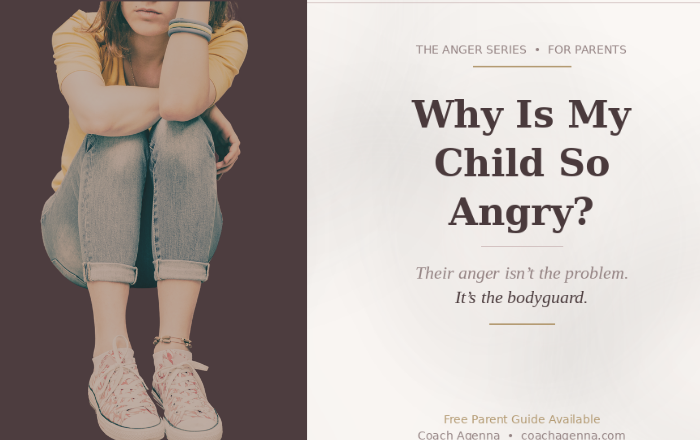
Anger Is Not the Problem
Here’s the thing most parenting advice gets wrong: it treats anger as the issue to be solved. Manage the anger. Control the outbursts. Teach them to calm down.
But anger is a secondary emotion. It’s not the fire — it’s the smoke alarm. Underneath your child’s anger is almost always one of these:
| “Shame. Fear. Rejection. Loneliness. Embarrassment. Feeling out of control.” |
Your child isn’t choosing anger. Their brain is choosing it for them. The same neurochemistry that floods an adult’s system when they get angry — adrenaline, cortisol, norepinephrine, dopamine — floods your child’s system too. Except their prefrontal cortex, the part that puts the brakes on, won’t be fully developed until their mid-twenties.
So when your 8-year-old throws a pencil over long division, they’re not being dramatic. Their brain just treated “I can’t do this” as a threat. The bodyguard showed up. And the bodyguard doesn’t do nuance.
What the Bodyguard Looks Like at Different Ages
The bodyguard shows up early. But what it’s protecting changes as your child grows.
Ages 3–6: “I’m losing you.”
At this age, anger is almost always about connection. They’re frustrated because they can’t do something, overwhelmed because the world is too big, or terrified that your attention or love is going somewhere else. The tantrum isn’t manipulation. It’s a small person whose nervous system just got flooded and they have zero tools to deal with it.
Ages 7–10: “I’m not good enough.”
School introduces performance. Comparison. Rankings. Your child starts measuring themselves against other kids, and the inner critic starts writing its rulebook. Anger at this age often protects shame — shame about not being smart enough, fast enough, liked enough. The homework meltdown isn’t about homework. It’s about “What if I’m stupid?”
Ages 11–14: “Do I matter?”
Welcome to the identity years. Everything is about belonging, rejection, and figuring out who they are. The anger gets sharper because the stakes feel existential. A friend group exclusion feels like the end of the world because, to their developing brain, it kind of is. The bodyguard is working overtime.
Ages 15–18: “Who am I — and do I get to decide?”
All of the above, plus autonomy. They’re fighting for control of their own identity, which means they’re pushing against yours. The defiance isn’t disrespect — it’s differentiation. That doesn’t make it easy. But understanding it changes how you respond.
The One Question That Changes Everything
Most parents, when their child gets angry, ask some version of: Why are you so angry?
It’s a fair question. But it’s the wrong one. Because your child doesn’t know why they’re angry. They just know they are. Asking “why” puts them on the spot, and the bodyguard digs in deeper.
Try this instead:
| “What happened right before you got angry?” |
This question does something different. It redirects their attention from the anger itself to the moment before the anger. The trigger. The original feeling. The thing the bodyguard is standing in front of.
You won’t always get an answer. That’s okay. You’re not interrogating them. You’re teaching them to rewind. Over time, they start doing it on their own. And that’s the beginning of emotional awareness.
Five Moments You’ll Recognize
Let me show you what the bodyguard looks like in real life.
The Homework Meltdown
Your child throws the pencil, crumples the paper, says “I can’t do this! I’m so stupid!”
Underneath: Shame. They feel inadequate and they’re terrified you’ll confirm it.
Try this: “This is hard. Hard doesn’t mean you can’t do it. Let’s look at it together.”
The After-School Explosion
They walk in the door and immediately pick a fight with a sibling or snap at you over nothing.
Underneath: They held it together all day at school. You’re their safe person. The bodyguard finally gets to stand down — and everything comes out.
Try this: “Rough day? You don’t have to talk about it yet. I’m here when you’re ready.”
The “It’s Not Fair!” Outburst
A sibling gets something they didn’t. They explode about fairness.
Underneath: They feel unseen. The fairness complaint is a proxy for “Do I matter as much?”
Try this: “I hear you. That does feel unfair. Tell me more about what’s bothering you.”
The Silent Shutdown
They won’t talk. Monosyllabic answers. The wall goes up.
Underneath: This is the quiet bodyguard. Instead of exploding outward, they’re protecting inward. Usually fear or deep hurt.
Try this: Don’t push. Sit near them. Say “I’m not going anywhere” and mean it. Let silence be okay.
The Defiant “You Can’t Make Me”
They refuse a reasonable request. Everything becomes a power struggle.
Underneath: Loss of control. Something in their world feels out of their hands, so they’re gripping whatever they can.
Try this: Offer a choice instead of a command. “Do you want to do this now or in ten minutes?” Agency calms the bodyguard.
What Not to Do (The Hard Part)
Most of what we do instinctively when a child gets angry actually reinforces the cycle.
Don’t match their volume. When you yell back, you confirm that anger is how big feelings get handled. They’re watching you for how to do this.
Don’t dismiss the feeling. “You’re fine” and “It’s not a big deal” teach them their emotions are wrong. The bodyguard gets louder when it’s dismissed.
Don’t punish the anger itself. Punish harmful behavior, yes. But anger is an emotion, not a behavior. “You’re not allowed to be angry” becomes a rule in their inner critic’s rulebook — one they’ll carry for decades.
Don’t fix it immediately. Sometimes they don’t need a solution. They need to feel felt. Sit with them before you fix for them.
Don’t take it personally. When your child rages at you, it’s almost never about you. You’re the safest person in their world. The bodyguard stands down around safe people, and everything underneath comes flooding out. That’s actually a compliment. A painful one. But a compliment.
Teaching Kids to Catch the Bodyguard
Kids live in their bodies. They feel anger physically before they can name it. One of the most powerful things you can do is help them learn where anger shows up:
“My hands get tight.” “My tummy feels weird.” “My face gets hot.” “My chest feels squeezy.” “I feel like I want to run.”
Don’t do this during a meltdown. Do it after, when things are calm. Or make it a game: “Where does angry live in your body?”
Over time, they’ll start catching it themselves: “Mom, my hands are doing the thing.” That’s a child learning to notice the bodyguard before it takes over. That’s emotional intelligence in real time.
The Sentence That Changes Everything
When the bodyguard shows up in your kid, here’s the most powerful thing you can say:
|
“I can see you’re really upset.
I’m not going anywhere.
Whenever you’re ready, I’m here.”
|
It validates without fixing. It provides safety without permissiveness. It gives them agency without abandonment.
You won’t say it perfectly every time. You’ll lose your patience. You’ll yell when you meant to stay calm. That’s okay. Repair is part of the process. “I got frustrated and I yelled. That wasn’t fair to you. I’m sorry.” That’s modeling exactly what you want them to learn.
The Goal
| “The goal isn’t to raise kids who never get angry. It’s to raise kids who know what their anger is protecting — and have the words to say so.” |
That starts with you. The way you respond to your child’s anger is teaching them how to respond to their own. Every single time.
If you want to understand your own anger cycle first, the full Anger Series walks you through it in five posts. Start with Part 1: Anger Is the Bodyguard, Not the Boss.
|
Want to go deeper?
I built a free parent guide called The Bodyguard in Your Kid — a short, practical resource that walks you through five real scenarios, age-by-age breakdowns, body scan exercises for kids, and journal prompts for your own anger patterns. Download it free.
If this hit close to home, coaching is where we take conversations like this and turn them into real, lasting change. You can book a free discovery call at coachagenna.com.
You shouldn’t have to figure this out alone. With coaching, you won’t.
|
The Anger Series:
Part 1: Anger Is the Bodyguard, Not the Boss
Part 2: Why Does Anger Feel So Good?
Part 3: Your Inner Critic and Anger
Part 4: Why Do I Keep Going Back to Anger?
Part 5: What Does the Bible Say About Anger?
NEW: Why Is My Child So Angry? (You are here)
FAQ SCHEMA
Q: Why is my child so angry all the time?
A: Anger in children is almost always a secondary emotion. Underneath it is usually shame, fear, rejection, embarrassment, or a feeling of being out of control. Children don’t have the vocabulary to name these emotions, so the anger does the talking.
Q: How do I help my angry child calm down?
A: Instead of telling them to calm down, try asking “What happened right before you got angry?” This redirects their attention from the anger to the original feeling underneath. Validate their emotion, provide safety, and give them time.
Q: Is it normal for kids to have angry outbursts?
A: Yes. Children’s prefrontal cortex won’t fully develop until their mid-twenties, which means their ability to regulate emotions is still being built. Angry outbursts are their nervous system responding to perceived threats with limited tools.
Q: Should I punish my child for being angry?
A: Punish harmful behavior, not the emotion. Anger is a feeling, not a behavior. Teaching a child that anger itself is wrong creates a rule in their inner critic that they’ll carry into adulthood.
Q: Why does my child only get angry with me?
A: Because you’re their safe person. Children hold themselves together at school and around peers, then release everything with the person they trust most. It’s actually a sign of secure attachment, even though it doesn’t feel like it.


Recent Comments