877-724-3662 [email protected]

What Does the Bible Say About Anger?

THE ANGER SERIES  •  PART 5 OF 5

What Does the Bible Say About Anger?

When psychology names the pattern and the gospel provides the power source

By Coach Agenna  |  coachagenna.com
Reading time: 7–8 minutes

If you’ve been reading this series from the beginning, you now understand something most people never see.

Anger is a secondary emotion. Your brain rewards it with dopamine. Your inner critic triggers the shame that fuels it. And the whole cycle is driven by an identity built on things that can be threatened.

Psychology names the pattern. It maps the cycle. It gives you language for what’s happening inside your body and your brain. And that language matters — deeply.

But psychology doesn’t answer every question the anger cycle raises. It can tell you what’s happening. It can show you why. But it can’t give you an identity that doesn’t need a bodyguard.

That’s where faith enters the conversation.

Paul Described It Two Thousand Years Ago

In Romans 7, Paul writes something so honest it still stops people in their tracks: “I do not do the good I want to do, but the evil I do not want to do — this I keep on doing.”

Read that again. That’s not a theological abstraction. That’s a man describing the exact cycle we’ve been unpacking for four blog posts.

I know the pattern. I understand what’s happening. I’ve committed to doing better. And I keep doing the thing I swore I wouldn’t do.

Paul didn’t have the language of neurochemistry or the amygdala or dopamine. But he described the experience perfectly. The gap between knowing and doing. The frustration of watching yourself repeat a cycle you understand but can’t seem to stop.

If you’ve ever felt that gap — if you’ve ever known exactly what you should do and done the opposite anyway — you’re not broken. You’re human. Paul knew it. God knows it too.

“Be Angry and Do Not Sin”

One of the most misunderstood verses about anger is Ephesians 4:26: “In your anger do not sin. Do not let the sun go down while you are still angry.”

For years, many people have read this as: Don’t be angry. Anger is sin. Good Christians don’t get angry.

But that’s not what it says. Read it again.

“In your anger” — not “if you get angry.” Paul assumes you will. Anger is a given. It’s baked into your neurology. God designed a brain with an amygdala. He’s not surprised when it fires.

The instruction isn’t to eliminate anger. It’s to not let anger drive the car. Feel it. Name it. But don’t hand it the keys to your mouth, your relationships, or your decisions.

And don’t let it sit overnight and harden into bitterness. That’s the second part. Anger that isn’t processed becomes resentment. Resentment becomes a lens you see everything through. And a person who sees everything through resentment will find something to be angry about in every room they walk into.

God Is Slow to Anger. Not Anger-Free.

Psalm 103:8 says: “The Lord is compassionate and gracious, slow to anger, abounding in love.”

Slow to anger. Not incapable of it. Not above it. Slow to it.

That phrase tells us something important. Anger, in the right context, is not a moral failure. Even God experiences it. But the speed matters. The space between the trigger and the response matters. What you do in that space is everything.

Being slow to anger is not about suppression. It’s about capacity. It’s having enough room inside yourself to feel the real feeling before anger takes over. It’s the ability to sit in the gap — the gap between what happened and what you’re about to do — and choose a response instead of a reaction.

That capacity isn’t something you’re born with. It’s built. Through practice, through healing, through the slow and unglamorous work of becoming a person who can tolerate discomfort without being destroyed by it.

What Faith Offers That Psychology Can’t

Psychology gives you the map. It shows you the cycle, names the chemicals, and identifies the patterns. That’s valuable and necessary work. Everything we’ve covered in Parts 1 through 4 is grounded in research, neuroscience, and clinical observation.

But psychology can’t give you an identity that doesn’t need defending.

In Part 4, we talked about how the anger cycle is driven by identity threats — the fear that losing a fight means losing yourself. The solution isn’t more willpower. It’s an identity built on something that can’t be taken.

The gospel offers exactly that.

An identity that isn’t earned. That means it can’t be lost through failure. An identity that isn’t performance-based. That means it doesn’t need constant protection. An identity that doesn’t depend on your output, your reputation, your spouse’s opinion, or your children’s behavior.

When your identity is rooted in something that can’t be threatened, your brain stops treating every hard conversation as a survival event. The bodyguard doesn’t retire overnight. But it has less and less reason to show up.

Grace Doesn’t Lower the Standard. It Changes the Power Source.

There’s a misconception that grace means lowering the bar. That if God already accepts you, there’s no reason to do the work.

That’s not how grace works.

Grace doesn’t mean you stop doing the work. It means you do the work from a different starting point. Not striving to earn your worth. Resting in it. And building from there.

A person who believes they have to earn their value will defend it with anger every time it’s questioned. A person who believes their value is settled—not because of what they’ve done, but because of whose they are—can afford to be curious instead of combative, humble instead of hostile, and present instead of defensive.

That’s not weakness. That’s the strongest foundation a person can stand on.

Bringing It All Together

Over five posts, we’ve walked through the anatomy of anger from the outside in:

Part 1: Anger is a secondary emotion—the bodyguard, not the boss.

Part 2: Your brain rewards anger with dopamine, trading vulnerability for force.

Part 3: Your inner critic triggers the shame that fuels the anger cycle.

Part 4: The anger cycle is driven by identity — when losing feels like dying.

Part 5: Psychology names the pattern. Faith provides an identity that doesn’t need a bodyguard.

None of these posts are about eliminating anger. Anger is human. It’s neurological. God designed the system. The goal isn’t to never feel angry. The goal is to become a person whose anger doesn’t run the show. A person with enough capacity to feel the real feeling, name it, and choose what comes next.

That person isn’t built in five blog posts. They’re built in daily practice, in honest relationships, in the slow work of healing, and in the quiet belief that your worth was settled before you ever had to defend it.


If this series has stirred something in you and you’re ready to do the deeper work, coaching is the next step.

Book a free discovery call at coachagenna.com.

You shouldn’t have to earn your worth in every room you walk into. With coaching, you won’t.

If you’re healing from trauma and want to do it privately, on your own terms, my book can help:

Healing What Hides in the Shadows: A Private Journey Through Sexual Trauma Recovery

Available on Amazon. healingwhathidesintheshadows.com

Want to go deeper with this series?

Download the free Anger Series Companion Guide — five weeks of journaling prompts, exercises, and awareness practices that walk you through everything the bodyguard is protecting.

THE ANGER SERIES — COMPLETE

Part 1: Anger Is the Bodyguard, Not the Boss

Part 2: Why Does Anger Feel So Good?

Part 3: Your Inner Critic and Anger

Part 4: Why Do I Keep Going Back to Anger?

Part 5: What Does the Bible Say About Anger?  ←  You are here


FAQ

Q: What does the Bible say about anger? A: The Bible acknowledges anger as a human experience, not inherently sinful. Ephesians 4:26 says “In your anger do not sin,” assuming anger will happen. Psalm 103:8 describes God as “slow to anger.” The biblical framework focuses on what you do with anger, not whether you feel it.

Q: Is anger a sin according to the Bible? A: Anger itself is not a sin. Ephesians 4:26 specifically distinguishes between feeling anger and sinning in anger. Even God is described as experiencing anger. The sin is in letting anger control your actions, harden into bitterness, or drive you to harm others.

Q: What does ‘be angry and do not sin’ mean? A: This verse from Ephesians 4:26 means anger is expected and human, but it should not drive your decisions or behavior. Feel the anger, name it, but don’t hand it control over your words, relationships, or choices. The second half warns against letting anger persist into bitterness.

Q: How does faith help with anger? A: Faith offers an identity that isn’t built on performance, approval, or control — things that trigger anger when threatened. When your sense of worth is rooted in something that can’t be earned or lost, your brain stops treating every challenge as a survival event, reducing the anger response.

Why Do I Keep Going Back to Anger?

THE ANGER SERIES  •  PART 4 OF 5

Why Do I Keep Going Back to Anger?

When losing a fight feels like losing yourself

By Coach Agenna  |  coachagenna.com

Reading time: 7–8 minutes

You’ve done the work. You’ve read the articles. You understand that anger is a secondary emotion, that your brain rewards it with dopamine, and that your inner critic is pulling the strings. You know the pattern.

And you keep doing it anyway.

You swore you wouldn’t blow up at dinner again. You promised yourself you’d pause before reacting. You told your spouse, your kid, your therapist, your God—this time will be different.

And then it wasn’t.

So you’re left with the question that haunts every person trapped in the anger cycle: Why do I keep going back to anger when I know it’s not working?

The answer isn’t willpower. It’s not discipline. It’s not that you haven’t tried hard enough.

The answer is identity.

Anger Is Protecting More Than Your Feelings

In Part 1, we talked about anger as the bodyguard standing in front of vulnerability. In Part 2, we explored the neurochemical reward system that makes anger feel good. In Part 3, we met the inner critic—the voice that triggers shame, which triggers anger.

Now we go to the deepest layer.

Anger isn’t just protecting you from uncomfortable feelings. It’s protecting your identity.

Think about the last time someone challenged something fundamental about who you believe you are. Not a minor disagreement — something that hit the core. Your competence. Your role as a parent. Your value in a relationship. Your worth as a provider, a leader, a person of faith.

What happened? Anger. Fast. Hot. Disproportionate to the actual situation.

That’s because your brain doesn’t process identity threats the same way it processes disagreements about where to eat dinner. Identity threats activate the same neural pathways as physical threats. When someone challenges who you believe you are, your brain responds as if you are in danger. Because in a very real neurological sense, you are. Not physically. But at the level of self.

The Things We Build Our Identity On

Here’s where this gets personal.

Most of us have built our identity on things that can be threatened. Our career. Our reputation. Our role in the family. Our spouse’s opinion of us. Our children’s behavior. Our performance. Our appearance. Our success.

None of those things are bad. But when any of them become the foundation of your identity—the thing you believe makes you valuable, worthy, or acceptable—it becomes something you’ll defend with everything you’ve got.

And the weapon your brain reaches for first is anger.

This is why a comment about your parenting can send you into a rage that lasts for hours. It’s not about the comment. It’s that the comment threatened the thing you’ve built your sense of self on. And losing that feels like dying — not physically, but at the deepest level of who you believe you are.

Tim Keller called these things “counterfeit gods”—good things that we’ve elevated to ultimate things. When a good thing becomes an ultimate thing, we will sacrifice anything to protect it. Including our relationships, our peace, and our integrity.

The Cycle That Keeps You Stuck

Here’s the full cycle, from the inside out:

Something threatens your identity. Your inner critic confirms the threat: You’re failing. You’re not enough. They’re going to see through you. Shame floods in. Your brain reaches for anger because anger feels like power and power feels like survival. You react. You say the thing, slam the door, shut down, lash out. The moment passes. And then guilt arrives. Guilt feeds the inner critic. The critic confirms you’re deficient. And the whole thing starts again.

Identity threat → Critic → Shame → Anger → Reaction → Guilt → Critic → Repeat.

This is why knowing the pattern isn’t enough to break it. The cycle is self-reinforcing. Each lap makes the next one more automatic. And every time you go around, the groove gets deeper.

Why Willpower Fails

Willpower lives in your prefrontal cortex—the rational, planning, future-thinking part of your brain. It’s the part that made the promise at 10 p.m. that tomorrow would be different.

But identity threats are processed in your amygdala — the survival center. The amygdala operates faster than the prefrontal cortex, processes threats before you’re consciously aware of them, and doesn’t care about your promises.

You’re not weak for failing to control your anger through willpower. You’re trying to use a slow system to override a fast one. It’s like trying to outrun a car on foot. You can try harder, but the architecture is working against you.

Breaking the anger cycle doesn’t require more willpower. It requires a different foundation.

Building on Something That Can’t Be Threatened

If the anger cycle is fueled by identity threats, the way out is an identity that can’t be threatened.

Not an identity built on performance, approval, success, or control. Those can always be taken. And anything that can be taken will always need a bodyguard.

The work here is asking yourself: What would I be if I couldn’t earn it, prove it, or perform it? What would remain if every external validator disappeared?

For some people, the answer is found in faith—an identity rooted in something that doesn’t depend on your output. We’ll explore that more deeply in Part 5.

For others, the answer starts with a simpler but equally radical shift: separating who you are from what you do. You are not your job title. You are not your parenting scorecard. You are not your spouse’s opinion of you on their worst day. You are not the last mistake you made.

When your identity doesn’t depend on the outcome of every conversation, your brain stops treating every conversation as a survival event. And when conversations stop being survival events, anger stops being the first responder.

What to Do With This

First, identify your identity anchors. What are the things that, when threatened, send you straight to anger? Your competence? Your role as a provider? Your need to be right? Your reputation? Write them down. These are the things your anger is protecting — and they’re the things you’ve built too much of your identity on.

Second, notice the disproportionate reactions. When your anger is bigger than the situation warrants, that’s a signal. Your brain isn’t reacting to what just happened. It’s reacting to what it thinks is at stake—which is your identity. Ask yourself: What did that moment threaten about who I believe I am?

Third, begin the slow work of building a sturdier foundation. This might look like therapy, coaching, faith work, or simply the daily practice of reminding yourself: I am not what I produce. I am not what people think of me. My worth is not up for debate in every interaction.

Coming Next

In Part 5 — the final post in this series — we’re bringing all of this together through a different lens. Paul described the anger struggle two thousand years before psychology gave it a name: “What I want to do I do not do.”

Part 5 asks: What does the Bible actually say about anger? And what does faith offer that psychology can’t?


If the anger cycle has you exhausted and you’re ready to build on a foundation that doesn’t crack, coaching can help.

Book a free discovery call at coachagenna.com.

You shouldn’t have to defend your worth in every conversation. With coaching, you won’t.

Want to go deeper with this series?

Download the free Anger Series Companion Guide — five weeks of journaling prompts, exercises, and awareness practices that walk you through everything the bodyguard is protecting.

THE ANGER SERIES

Part 1: Anger Is the Bodyguard, Not the Boss

Part 2: Why Does Anger Feel So Good?

Part 3: Your Inner Critic and Anger

Part 4: Why Do I Keep Going Back to Anger?  ←  You are here

Part 5: What Does the Bible Say About Anger?

FAQ 

Q: Why do I keep going back to anger? A: Anger often protects your identity, not just your feelings. When something threatens who you believe you are — your competence, your role, your worth — your brain treats it as a survival-level threat and sends anger as a first responder. The cycle is self-reinforcing and cannot be broken through willpower alone.

Q: Why can’t I control my anger with willpower? A: Willpower operates in the prefrontal cortex, which is slower than the amygdala where identity threats are processed. Your survival brain fires before your rational brain has time to intervene. Breaking the cycle requires a different identity foundation, not more effort.

Q: What is the anger cycle? A: The full anger cycle is: identity threat → inner critic → shame → anger → reaction → guilt → inner critic → repeat. Each cycle reinforces the next, making the pattern more automatic over time.

Q: How do I break the anger cycle? A: Start by identifying what your anger is actually protecting — usually an aspect of your identity. Then begin building your sense of self on things that can’t be threatened by a single conversation or event. This often involves coaching, therapy, or faith-based identity work.

Your Inner Critic and Anger

THE ANGER SERIES  •  PART 3 OF 5

Your Inner Critic and Anger

The voice that hired the bodyguard—and how to relieve it of duty

By Coach Agenna  |  coachagenna.com

Reading time: 7–8 minutes

You already know anger is a secondary emotion. You know your brain trades vulnerability for fury because the dopamine hit feels better than sitting with shame. You’ve met the bodyguard.

Now it’s time to meet the person who hired it.

Your inner critic.

That voice in your head that says you’re not enough. The one that keeps score, keeps track of every mistake, and replays your worst moments at 2 a.m. The one that whispers “you should have known better” and “who do you think you are?”

If anger is the bodyguard, your inner critic is the one standing behind it giving orders. And until you understand where that voice came from and what it’s trying to protect, you’ll keep fighting a bodyguard that has no intention of standing down.

Where the Inner Critic Comes From

Your inner critic didn’t show up the day you turned thirty and started questioning your life choices. It’s been with you since childhood. And here’s the part that changes everything: it was trying to help.

When you were a kid, your brain did something remarkable. It studied the people around you — parents, teachers, coaches, pastors, peers — and it wrote a rulebook. The rulebook was designed to answer one question: What do I need to do to be safe, loved, and accepted in this environment?

If your environment said, “Don’t cry,” the rulebook said, “Emotions are weakness; shut them down.”

If your environment said, “Be perfect or be punished,” the rulebook said, “Mistakes are dangerous. Never make one.”

If your environment said, “You’re too much” or “You’re not enough,” the rulebook said, “Shrink. Perform. Earn your place.”

Your inner critic is the enforcer of that rulebook. It repeats those rules because, at one point in your life, following them kept you alive. Or at least kept you from being yelled at, abandoned, hit, or humiliated.

The problem is, you’re not a kid anymore. But nobody told the enforcer.

How Your Inner Critic and Anger Work Together

Here’s how the cycle works. Pay attention, because this is the part most people never see.

Something happens. Someone criticizes you at work. Your spouse makes a comment about the dishes. Your kid rolls their eyes. It’s small. It shouldn’t matter. But it does.

Before you even have time to process the moment, your inner critic fires first. Not anger, the critic. It says, “See?” You can’t do anything right. You’re failing. You’re not enough.

That voice triggers the real feeling underneath: shame. Inadequacy. Fear that the rulebook is right and you really are deficient in some fundamental way.

And that feeling is unbearable. So your brain does what it always does. It sends the bodyguard. Anger floods in. Suddenly you’re not a person sitting with shame—you’re a person with a target. The dishes aren’t the issue. Your spouse’s tone is the issue. Your kid’s attitude is the issue. Your boss’s incompetence is the issue.

The anger feels righteous. It feels justified. But it started with the critic.

Inner critic triggers shame. Shame triggers anger. Anger finds a target. And the real wound never gets touched.

The Rulebook Nobody Told You to Question

Most people have never examined the rulebook their inner critic enforces. They just follow it. They assume the rules are true because they’ve had them so long they feel like facts.

But rules are not facts. Rules are strategies a child created to survive a specific environment. And strategies that worked at seven don’t always work at thirty-seven.

“Don’t show weakness” might have protected you in a household where vulnerability was punished. But it’s destroying your marriage.

“Be perfect or don’t try” might have kept you safe from a critical parent. But it’s keeping you stuck in a career you’ve outgrown.

“Don’t trust anyone” might have been smart in a home where trust was regularly betrayed. But it’s isolating you from people who actually want to be close.

Your inner critic isn’t evil. It’s outdated. It’s running a program written by a kid who didn’t have the language, the power, or the options you have now.

You Don’t Destroy the Critic. You Relieve It of Duty.

This is where most people get it wrong. They hear “inner critic” and think, I need to silence that voice. Kill it. Argue with it. Overpower it.

But fighting the critic is just another version of fighting the bodyguard. You’re still at war with yourself. And wars with yourself don’t produce peace. They produce exhaustion.

Instead, try something that feels counterintuitive: thank it.

Thank you. I know you were trying to protect me. I know you learned these rules because they kept me safe once. But I’m not that kid anymore. I have resources now that I didn’t have then. I have language for what I feel. I have people I can trust. I have the ability to sit with discomfort without being destroyed by it.

You don’t have to carry this anymore. I’ve got it from here.

That phrase—”I’ve got it from here”—is one of the most powerful things you can say to your inner critic. It’s not dismissive. It’s not aggressive. It acknowledges what the critic did for you and gently releases it from a job it was never meant to hold forever.

I've got it from here quote image

What to Do With This

If you’re reading this and recognizing the voice, here are three things to try this week:

First, catch the critic before the anger. The next time you feel anger surge, pause and rewind. What did the voice say right before the anger showed up? Was it “you’re not enough”? Was it “you’re going to lose this”? Was it “they don’t respect you”? That voice is the critic, and the critic is the real starting point.

Second, name the rule. What rule did your inner critic enforce in that moment? Where did that rule come from? Who taught it to you? Was it true then? Is it true now? You don’t have to answer all of those questions at once. But asking them interrupts the autopilot.

Third, say the five words. When the critic speaks, respond: “I’ve got it from here.” Say it out loud if you need to. Write it on a sticky note. Put it on your mirror. Those five words are not a magic spell. They’re a practice. And every time you say them, you’re teaching your brain that the old rulebook is retired.

Coming Next

In Part 4 of the Anger Series, we’re tackling the question that keeps people stuck: Why do I keep going back to anger even when I know it’s not working?

The answer has to do with identity. When losing a fight feels like losing yourself—not physically, but at the level of who you believe you are—your brain will send the bodyguard every single time. Part 4 is about breaking that cycle.


If your inner critic has been running the show and you’re ready to rewrite the rulebook, coaching can help.

Book a free discovery call at coachagenna.com.

You shouldn’t have to live by rules a scared kid wrote. With coaching, you won’t.

Want to go deeper with this series?

Download the free Anger Series Companion Guide — five weeks of journaling prompts, exercises, and awareness practices that walk you through everything the bodyguard is protecting.

THE ANGER SERIES

Part 1: Anger Is the Bodyguard, Not the Boss

Part 2: Why Does Anger Feel So Good?

Part 3: Your Inner Critic and Anger ← You are here

Part 4: Why Do I Keep Going Back to Anger?

Part 5: What Does the Bible Say About Anger?


FAQ 

Q: What is the connection between the inner critic and anger? A: The inner critic triggers shame or inadequacy by enforcing old childhood rules. When shame becomes unbearable, the brain sends anger as a protective response. The cycle is the inner critic triggers shame, shame triggers anger, and anger finds a target.

Q: Where does the inner critic come from? A: The inner critic develops in childhood as a survival strategy. A child’s brain studies its environment and writes a rulebook to answer the following: What do I need to do to be safe, loved, and accepted? The inner critic enforces that rulebook into adulthood, even when the rules no longer apply.

Q: How do I silence my inner critic? A: Rather than silencing or fighting the inner critic, a more effective approach is to acknowledge what it tried to do for you and relieve it of duty. Saying “Thank you. I’ve got it from here” interrupts the pattern without creating an internal war.

Q: Why does my inner critic make me angry? A: Your inner critic activates shame, inadequacy, or fear — emotions that are deeply uncomfortable. Your brain then trades those feelings for anger, which comes with a neurochemical reward of dopamine, adrenaline, and a false sense of control. The anger feels better than the shame, so the cycle repeats.

Why Does Anger Feel So Good?

THE ANGER SERIES  •  PART 2 OF 5

Why Does Anger Feel So Good?

The neurochemistry behind the emotion your brain keeps choosing

By Coach Agenna  |  coachagenna.com

Reading time: 7–8 minutes

Let’s be honest about something nobody talks about.

Anger feels good.

Not in the way you’d say out loud. Not in the way you’d admit at a dinner party or a small group or a therapy session. But somewhere in your body—when someone crosses a line, when someone dismisses you, when something feels deeply unfair—anger rises up, and it feels like power.

It feels like clarity. Like you finally know exactly what to say. Like every ounce of confusion you’ve been carrying just got organized into one clean, burning emotion.

And for a moment, it works.

So why does anger feel so good? And if it feels good, why does it keep making your life worse?

Your Brain on Anger: Why Anger Feels Good

Here’s what’s actually happening in your body when anger shows up.

When your brain perceives a threat—real or imagined—your amygdala fires before your prefrontal cortex has time to evaluate the situation. This is the fight-or-flight response, and anger is the fight side of that equation.

Within milliseconds, your body releases a cocktail of neurochemicals:

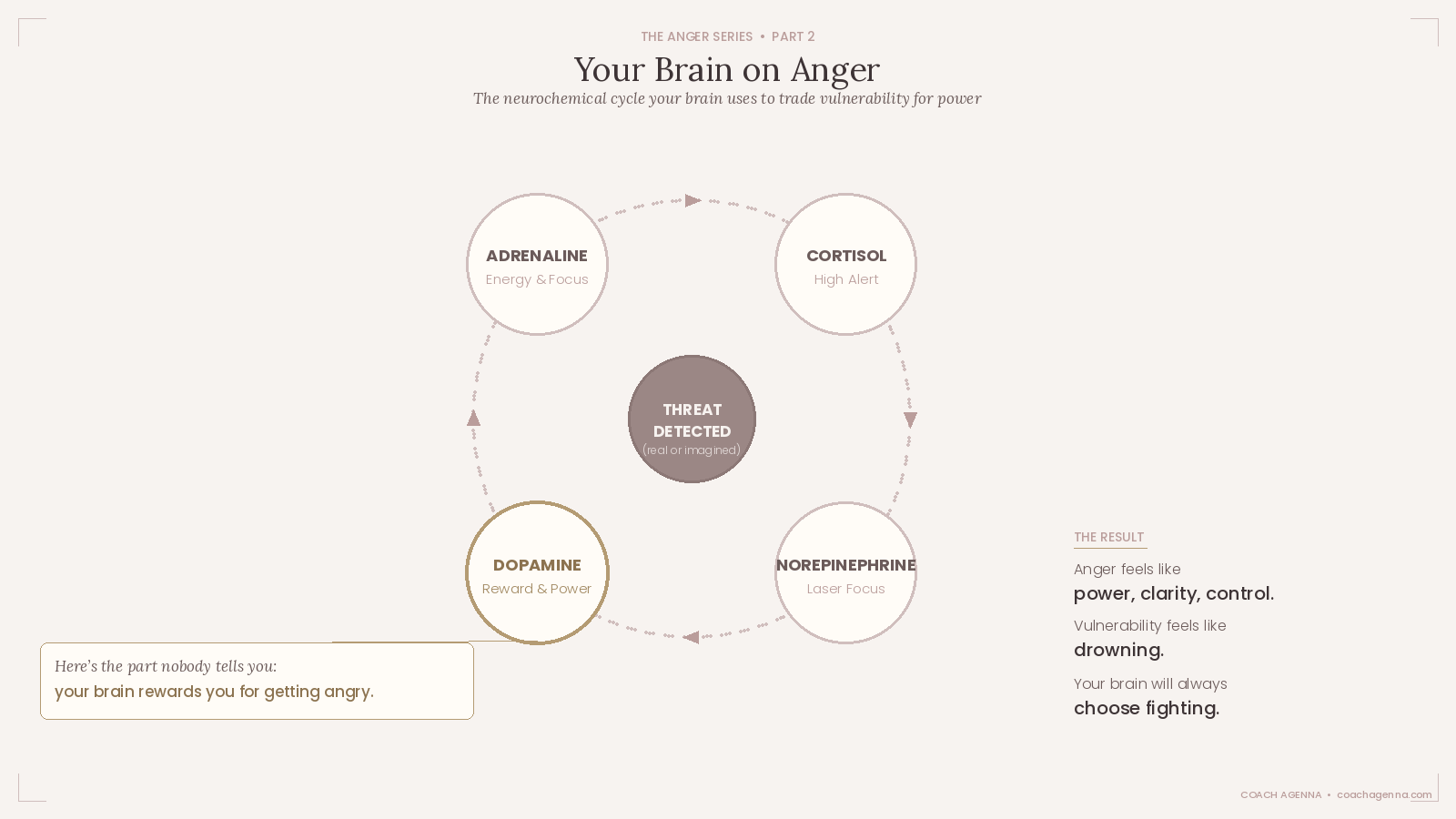
Adrenaline surges, giving you energy and focus. Cortisol floods your system, keeping you on high alert. Norepinephrine sharpens your attention, narrowing your focus to the threat. And—here’s the part nobody tells you—your brain releases dopamine. The same chemical associated with reward, pleasure, and motivation.

neurochemistry of anger cycle showing adrenaline cortisol norepinephrine and dopamine — Coach Agenna anger series part 2

That’s right. Your brain rewards you for getting angry.

Not because anger is good for you. But because your brain is designed to protect you, and anger feels like protection. Your nervous system doesn’t know the difference between a grizzly bear and a dismissive comment from your spouse. It just knows something feels threatening, and anger is the fastest way to make you feel powerful enough to survive it.

The Trade Your Brain Is Making

In Part 1 of this series, we talked about anger as a secondary emotion—the bodyguard standing in front of the thing you’re actually feeling. Rejection. Inadequacy. Loneliness. Fear. Shame.

Now let’s go one step deeper.

Your brain isn’t just hiding those emotions behind anger. It’s actively trading them for anger. Because anger comes with a neurochemical payoff that vulnerability doesn’t.

Think about the last time you felt deeply rejected. What did that feel like in your body? Probably heaviness. Tightness in your chest. A sinking feeling. Maybe even nausea. Your body doesn’t know what to do with rejection. There’s no clear action step. Rejection just… sits there.

Now think about the last time you got angry instead. What happened? Your body surged. Your jaw tightened. Your thoughts sharpened. Suddenly you weren’t a person sitting with an unbearable feeling. You were a person with something to say, something to do, someone to confront.

That’s the trade. Vulnerability feels like drowning. Anger feels like fighting. And your brain will always choose fighting.

Why “Just Calm Down” Doesn’t Work

This is why anger management strategies that focus on calming down rarely produce lasting change. Deep breathing, counting to ten, walking away—these are useful in the moment. They regulate the nervous system. They buy you time.

But they don’t address the real question: What is your anger protecting you from feeling?

If you only manage the anger without exploring what’s underneath it, your brain will keep making the same trade. Every single time. Because the reward system is still intact. The dopamine hit is still waiting. And the vulnerability underneath is still too uncomfortable to sit with.

This is why people who are “good at controlling their anger” often describe themselves as exhausted. They’re spending enormous energy suppressing something their brain is actively incentivized to produce.

The Real Question Behind the Anger

So if anger feels good because it protects you from harder feelings, the path forward isn’t to get rid of anger. It’s to become a person who can tolerate the feelings anger is covering.

That is an entirely different kind of work.

It looks like sitting with discomfort long enough to name it. It looks like asking, “What am I actually afraid of right now?” when your fists are clenched. It looks like noticing that the fury you feel about a work email is actually grief about something much older and much more personal.

Sitting with discomfort is one of the bravest things a person can do. It’s not passive. It’s not weak. It’s the decision to feel the real thing instead of the easy thing.

What Anger Is Costing You

Here’s the part your brain won’t tell you while it’s handing you the dopamine:

Anger has a cost.

It costs you relationships—because people stop being honest with someone who might explode. It costs you intimacy—because vulnerability is the price of admission, and anger keeps you locked out. It costs you your health—chronic anger is linked to increased risk of cardiovascular disease, weakened immune function, and elevated cortisol levels that disrupt sleep, digestion, and mood regulation.

And perhaps most importantly, it costs you self-knowledge. Every time anger answers the door before you can get there, you miss the chance to understand what you’re actually feeling. Over time, you lose fluency in your own emotional language. You stop being able to identify what’s hurt from what’s threatening from what’s just uncomfortable.

Anger becomes the only tool in the box. And when all you have is a hammer, everything looks like a nail.

A Different Kind of Strength

There’s a lie embedded in the neurochemistry of anger, and it goes like this: Feeling powerful is the same as being strong.

It’s not.

Power surges and then crashes. Strength is sustainable. Power pushes people away. Strength draws them in. Power protects the surface. Strength heals what’s underneath.

The kind of strength I’m talking about doesn’t look dramatic. It looks like a person in the middle of a hard conversation who says, “I’m not angry. I’m hurt.” It looks like someone who takes a breath—not to suppress the anger, but to get curious about it.

It looks like someone who stops fighting the bodyguard and starts asking what it’s protecting.

What to Do With This

If you’re reading this and recognizing yourself, here are three things to try this week:

First, notice the surge. The next time anger shows up, pay attention to the moment right before. Not the anger itself—the split second before the anger. What was the first feeling? Was it embarrassment? Fear? Rejection? That first feeling is the real one. Anger is the cover story.

Second, name it out loud. Say it to yourself, to a journal, to someone you trust. “I’m not angry. I’m scared.” “I’m not angry. I feel dismissed.” Naming the real emotion interrupts the trade your brain is trying to make.

Third, sit with the discomfort for thirty seconds longer than you want to. You don’t have to resolve it. You don’t have to fix it. Just don’t let anger replace it. Thirty seconds of real feeling is more transformative than thirty minutes of managed fury.

Coming Next

In Part 3 of the Anger Series, we’re going deeper—into the inner critic. If anger is the bodyguard, your inner critic is the one who hired it. Every “should” and “not enough” traces back to a rulebook written by a kid who was just trying to survive.

We’ll talk about how to relieve your inner critic of duty—without destroying it.


If you’re tired of the anger cycle and ready to explore what’s underneath, coaching can help.

Book a free discovery call at coachagenna.com.

You shouldn’t have to keep choosing anger because it’s the only emotion that feels safe. With coaching, you won’t.

Want to go deeper with this series?

Download the free Anger Series Companion Guide — five weeks of journaling prompts, exercises, and awareness practices that walk you through everything the bodyguard is protecting.

THE ANGER SERIES

Part 1: Anger Is the Bodyguard, Not the Boss

Part 2: Why Does Anger Feel So Good?  ←  You are here

Part 3: Your Inner Critic and Anger

Part 4: Why Do I Keep Going Back to Anger?

Part 5: What Does the Bible Say About Anger?

FAQ 

Q: Why does anger feel so good? A: Anger triggers a release of adrenaline, cortisol, norepinephrine, and dopamine. Your brain literally rewards you for getting angry because it interprets anger as a survival response. The result is a surge of energy, focus, and a false sense of control.

Q: Is anger a secondary emotion? A: Yes. Research in affective neuroscience shows that anger typically covers a more vulnerable primary emotion like fear, shame, rejection, or inadequacy. The brain trades the discomfort of vulnerability for the neurochemical payoff of anger.

Q: Why does anger management not work? A: Traditional anger management focuses on calming the anger response but doesn’t address the underlying emotions anger is protecting. Without exploring what’s underneath, the brain continues to default to anger because the reward system remains intact.

Q: How do I stop getting angry so easily? A: Start by noticing the feeling that comes right before anger. Name it out loud. Then practice sitting with that discomfort for thirty seconds longer than you want to. Over time, this builds your capacity to feel the real emotion instead of defaulting to anger.

Anger Is the Bodyguard, Not the Boss

THE ANGER SERIES  |  PART 1 OF 5

Anger Is the Bodyguard, Not the Boss

Why your anger isn’t the problem—it’s the cover story.

Someone I love sat across from me recently and said something so honest it stopped the whole conversation.

“I’m trying to figure out the exact moment I got angry today. And part of me—part of me actually wants to be angry.”

Then he paused.

“But when I get past the anger, I realize how much better it is. So why do I keep going back to it?”

That question. Right there. That’s the one most people never ask. “So why do I keep going back? Why am I angry all the time?

They stay in the anger. They justify it. They build a case for it. And they never get curious about what the anger is actually doing.

So let me tell you what I told him.

Anger Is a Secondary Emotion

Anger is not the thing. Anger is the thing that covers the thing.

Your brain is brilliant. When it senses a primary emotion that feels too vulnerable—rejection, loneliness, inadequacy, fear, or shame—it reaches for anger like a bodyguard stepping in front of a VIP. Anger feels powerful. Anger feels justified. Anger gives you something to do with the pain.

But anger is not the wound. It’s the armor.

The Gottman Institute, which has studied couples and emotional dynamics for over fifty years, calls this the Anger Iceberg. What people see on the surface—the raised voice, the sharp tone, the clenched jaw—is just the tip. Underneath the waterline, hidden from view, are the emotions anger is working overtime to protect: embarrassment, loneliness, exhaustion, fear, and shame.

And the reason your brain prefers anger? Because anger is easily justified. Think about it. When you’re angry, you can build an airtight case for why you have every right to feel the way you feel. You can point to the offense, the disrespect, and the injustice. You can make it about them.

But the primary emotion underneath? That’s about you. And that’s a much harder place to go.

Brené Brown, whose research on vulnerability and shame has shaped how we understand human emotion, puts it bluntly in Daring Greatly: anger “only serves as a socially acceptable mask for many of the more difficult underlying emotions we feel.” She says we’ve “confused feeling with failing and emotions with liabilities.”

That’s worth sitting with.

Your Brain on Anger

There’s a neuroscience reason this happens, and it’s not just metaphorical. Psychologist Daniel Goleman, in his groundbreaking book Emotional Intelligence, coined the term amygdala hijack to describe what happens when your brain’s emotional alarm system takes over before your rational mind can weigh in.

Here’s the short version: Your amygdala—a small, almond-shaped structure deep in your brain—is designed to detect threats. When it senses danger, it fires before your prefrontal cortex (the thinking, reasoning part of your brain) can even get online. Your heart rate spikes. Adrenaline floods your system. Your blood literally flows to your hands, preparing you to fight.

The problem? Your amygdala doesn’t know the difference between a physical threat and an emotional one. A dismissive comment from your spouse can trigger the same neurological cascade as a bear in the woods. And by the time your rational brain catches up, you’ve already said the thing, slammed the door, or shut down completely.

That’s not a character flaw. That’s biology. But understanding it gives you the power to interrupt it.

What If Anger Isn’t the Problem?

Most people treat anger like it’s the issue. They try to manage it, suppress it, or white-knuckle their way through it. But what if anger is actually a signal—a flashing light on your dashboard telling you something deeper needs attention?

What if the real question isn’t “Why am I so angry?” but “What discomfort am I not willing to sit with?”

That shift changes everything. Because now you’re not fighting the anger. You’re getting curious about it. You’re asking it what it’s protecting. And in my experience—both personally and as a coach—anger is almost always protecting one of these:

Rejection—the fear that you’re not wanted.

Inadequacy—the belief that you’re not enough.

Loneliness—the ache of being unseen.

Fear—the sense that something you value is at risk.

Shame—the story that says something is fundamentally wrong with you.

Every one of those is harder to feel than anger. Every one of those requires vulnerability. And vulnerability? That’s the last thing most of us want to offer when we’re already hurting.

Here’s What I Want You to Do

The next time anger shows up—and it will—don’t try to kill it. Don’t shame yourself for it. Instead, pause and ask:

What just happened right before I got angry?

What am I actually feeling underneath this?

What discomfort is this anger helping me avoid?

You don’t need to have the answer immediately. You just need to start asking. Because the moment you get curious about your anger instead of controlled by it, you take back the driver’s seat.

Goleman’s research shows it takes roughly six seconds for the stress chemicals from an amygdala hijack to begin to dissipate. Six seconds. That’s one deep breath. One pause. One choice to respond instead of react.

Start there.

Coming up in Part 2: We dig into what’s underneath the anger and why your brain would rather feel anything than sit with the real thing.

Want to go deeper with this series? Download the free Anger Series Companion Guide — five weeks of journaling prompts, exercises, and awareness practices that walk you through everything the bodyguard is protecting.

If this hit close to home, I’d love to help you go deeper. Coaching is where we take conversations like this and turn them into real, lasting change. You can learn more or book a free discovery call at coachagenna.com.