
Why Does Anger Feel So Good?
The neurochemistry behind the emotion your brain keeps choosing
By Coach Agenna | coachagenna.com
Reading time: 7–8 minutes
Let’s be honest about something nobody talks about.
Anger feels good.
Not in the way you’d say out loud. Not in the way you’d admit at a dinner party or a small group or a therapy session. But somewhere in your body—when someone crosses a line, when someone dismisses you, when something feels deeply unfair—anger rises up, and it feels like power.
It feels like clarity. Like you finally know exactly what to say. Like every ounce of confusion you’ve been carrying just got organized into one clean, burning emotion.
And for a moment, it works.
So why does anger feel so good? And if it feels good, why does it keep making your life worse?
Your Brain on Anger: Why Anger Feels Good
Here’s what’s actually happening in your body when anger shows up.
When your brain perceives a threat—real or imagined—your amygdala fires before your prefrontal cortex has time to evaluate the situation. This is the fight-or-flight response, and anger is the fight side of that equation.
Within milliseconds, your body releases a cocktail of neurochemicals:
Adrenaline surges, giving you energy and focus. Cortisol floods your system, keeping you on high alert. Norepinephrine sharpens your attention, narrowing your focus to the threat. And—here’s the part nobody tells you—your brain releases dopamine. The same chemical associated with reward, pleasure, and motivation.
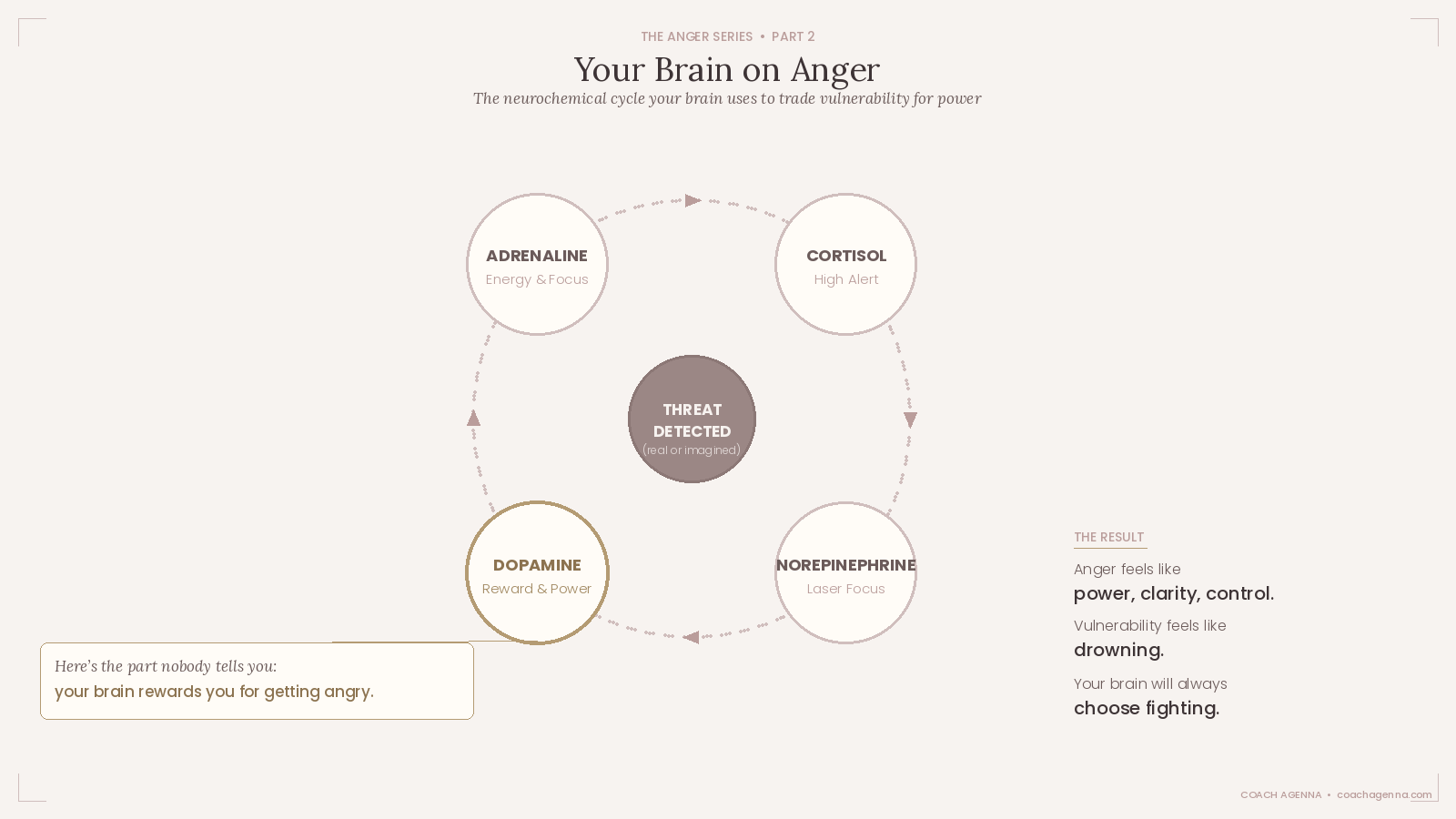
That’s right. Your brain rewards you for getting angry.
Not because anger is good for you. But because your brain is designed to protect you, and anger feels like protection. Your nervous system doesn’t know the difference between a grizzly bear and a dismissive comment from your spouse. It just knows something feels threatening, and anger is the fastest way to make you feel powerful enough to survive it.
The Trade Your Brain Is Making
In Part 1 of this series, we talked about anger as a secondary emotion—the bodyguard standing in front of the thing you’re actually feeling. Rejection. Inadequacy. Loneliness. Fear. Shame.
Now let’s go one step deeper.
Your brain isn’t just hiding those emotions behind anger. It’s actively trading them for anger. Because anger comes with a neurochemical payoff that vulnerability doesn’t.
Think about the last time you felt deeply rejected. What did that feel like in your body? Probably heaviness. Tightness in your chest. A sinking feeling. Maybe even nausea. Your body doesn’t know what to do with rejection. There’s no clear action step. Rejection just… sits there.
Now think about the last time you got angry instead. What happened? Your body surged. Your jaw tightened. Your thoughts sharpened. Suddenly you weren’t a person sitting with an unbearable feeling. You were a person with something to say, something to do, someone to confront.
That’s the trade. Vulnerability feels like drowning. Anger feels like fighting. And your brain will always choose fighting.
Why “Just Calm Down” Doesn’t Work
This is why anger management strategies that focus on calming down rarely produce lasting change. Deep breathing, counting to ten, walking away—these are useful in the moment. They regulate the nervous system. They buy you time.
But they don’t address the real question: What is your anger protecting you from feeling?
If you only manage the anger without exploring what’s underneath it, your brain will keep making the same trade. Every single time. Because the reward system is still intact. The dopamine hit is still waiting. And the vulnerability underneath is still too uncomfortable to sit with.
This is why people who are “good at controlling their anger” often describe themselves as exhausted. They’re spending enormous energy suppressing something their brain is actively incentivized to produce.
The Real Question Behind the Anger
So if anger feels good because it protects you from harder feelings, the path forward isn’t to get rid of anger. It’s to become a person who can tolerate the feelings anger is covering.
That is an entirely different kind of work.
It looks like sitting with discomfort long enough to name it. It looks like asking, “What am I actually afraid of right now?” when your fists are clenched. It looks like noticing that the fury you feel about a work email is actually grief about something much older and much more personal.
Sitting with discomfort is one of the bravest things a person can do. It’s not passive. It’s not weak. It’s the decision to feel the real thing instead of the easy thing.
What Anger Is Costing You
Here’s the part your brain won’t tell you while it’s handing you the dopamine:
Anger has a cost.
It costs you relationships—because people stop being honest with someone who might explode. It costs you intimacy—because vulnerability is the price of admission, and anger keeps you locked out. It costs you your health—chronic anger is linked to increased risk of cardiovascular disease, weakened immune function, and elevated cortisol levels that disrupt sleep, digestion, and mood regulation.
And perhaps most importantly, it costs you self-knowledge. Every time anger answers the door before you can get there, you miss the chance to understand what you’re actually feeling. Over time, you lose fluency in your own emotional language. You stop being able to identify what’s hurt from what’s threatening from what’s just uncomfortable.
Anger becomes the only tool in the box. And when all you have is a hammer, everything looks like a nail.
A Different Kind of Strength
There’s a lie embedded in the neurochemistry of anger, and it goes like this: Feeling powerful is the same as being strong.
It’s not.
Power surges and then crashes. Strength is sustainable. Power pushes people away. Strength draws them in. Power protects the surface. Strength heals what’s underneath.
The kind of strength I’m talking about doesn’t look dramatic. It looks like a person in the middle of a hard conversation who says, “I’m not angry. I’m hurt.” It looks like someone who takes a breath—not to suppress the anger, but to get curious about it.
It looks like someone who stops fighting the bodyguard and starts asking what it’s protecting.
What to Do With This
If you’re reading this and recognizing yourself, here are three things to try this week:
First, notice the surge. The next time anger shows up, pay attention to the moment right before. Not the anger itself—the split second before the anger. What was the first feeling? Was it embarrassment? Fear? Rejection? That first feeling is the real one. Anger is the cover story.
Second, name it out loud. Say it to yourself, to a journal, to someone you trust. “I’m not angry. I’m scared.” “I’m not angry. I feel dismissed.” Naming the real emotion interrupts the trade your brain is trying to make.
Third, sit with the discomfort for thirty seconds longer than you want to. You don’t have to resolve it. You don’t have to fix it. Just don’t let anger replace it. Thirty seconds of real feeling is more transformative than thirty minutes of managed fury.
Coming Next
In Part 3 of the Anger Series, we’re going deeper—into the inner critic. If anger is the bodyguard, your inner critic is the one who hired it. Every “should” and “not enough” traces back to a rulebook written by a kid who was just trying to survive.
We’ll talk about how to relieve your inner critic of duty—without destroying it.
If you’re tired of the anger cycle and ready to explore what’s underneath, coaching can help.
Book a free discovery call at coachagenna.com.
You shouldn’t have to keep choosing anger because it’s the only emotion that feels safe. With coaching, you won’t.
Want to go deeper with this series?
Download the free Anger Series Companion Guide — five weeks of journaling prompts, exercises, and awareness practices that walk you through everything the bodyguard is protecting.
THE ANGER SERIES
Part 1: Anger Is the Bodyguard, Not the Boss
Part 2: Why Does Anger Feel So Good? ← You are here
Part 3: Your Inner Critic and Anger
Part 4: Why Do I Keep Going Back to Anger?
Part 5: What Does the Bible Say About Anger?
FAQ
Q: Why does anger feel so good? A: Anger triggers a release of adrenaline, cortisol, norepinephrine, and dopamine. Your brain literally rewards you for getting angry because it interprets anger as a survival response. The result is a surge of energy, focus, and a false sense of control.
Q: Is anger a secondary emotion? A: Yes. Research in affective neuroscience shows that anger typically covers a more vulnerable primary emotion like fear, shame, rejection, or inadequacy. The brain trades the discomfort of vulnerability for the neurochemical payoff of anger.
Q: Why does anger management not work? A: Traditional anger management focuses on calming the anger response but doesn’t address the underlying emotions anger is protecting. Without exploring what’s underneath, the brain continues to default to anger because the reward system remains intact.
Q: How do I stop getting angry so easily? A: Start by noticing the feeling that comes right before anger. Name it out loud. Then practice sitting with that discomfort for thirty seconds longer than you want to. Over time, this builds your capacity to feel the real emotion instead of defaulting to anger.
Recent Comments