
What Does the Bible Say About Anger?
What Does the Bible Say About Anger?
When psychology names the pattern and the gospel provides the power source
By Coach Agenna | coachagenna.com
Reading time: 7–8 minutes
If you’ve been reading this series from the beginning, you now understand something most people never see.
Anger is a secondary emotion. Your brain rewards it with dopamine. Your inner critic triggers the shame that fuels it. And the whole cycle is driven by an identity built on things that can be threatened.
Psychology names the pattern. It maps the cycle. It gives you language for what’s happening inside your body and your brain. And that language matters — deeply.
But psychology doesn’t answer every question the anger cycle raises. It can tell you what’s happening. It can show you why. But it can’t give you an identity that doesn’t need a bodyguard.
That’s where faith enters the conversation.
Paul Described It Two Thousand Years Ago
In Romans 7, Paul writes something so honest it still stops people in their tracks: “I do not do the good I want to do, but the evil I do not want to do — this I keep on doing.”
Read that again. That’s not a theological abstraction. That’s a man describing the exact cycle we’ve been unpacking for four blog posts.
I know the pattern. I understand what’s happening. I’ve committed to doing better. And I keep doing the thing I swore I wouldn’t do.
Paul didn’t have the language of neurochemistry or the amygdala or dopamine. But he described the experience perfectly. The gap between knowing and doing. The frustration of watching yourself repeat a cycle you understand but can’t seem to stop.
If you’ve ever felt that gap — if you’ve ever known exactly what you should do and done the opposite anyway — you’re not broken. You’re human. Paul knew it. God knows it too.
“Be Angry and Do Not Sin”
One of the most misunderstood verses about anger is Ephesians 4:26: “In your anger do not sin. Do not let the sun go down while you are still angry.”
For years, many people have read this as: Don’t be angry. Anger is sin. Good Christians don’t get angry.
But that’s not what it says. Read it again.
“In your anger” — not “if you get angry.” Paul assumes you will. Anger is a given. It’s baked into your neurology. God designed a brain with an amygdala. He’s not surprised when it fires.
The instruction isn’t to eliminate anger. It’s to not let anger drive the car. Feel it. Name it. But don’t hand it the keys to your mouth, your relationships, or your decisions.
And don’t let it sit overnight and harden into bitterness. That’s the second part. Anger that isn’t processed becomes resentment. Resentment becomes a lens you see everything through. And a person who sees everything through resentment will find something to be angry about in every room they walk into.
God Is Slow to Anger. Not Anger-Free.
Psalm 103:8 says: “The Lord is compassionate and gracious, slow to anger, abounding in love.”
Slow to anger. Not incapable of it. Not above it. Slow to it.
That phrase tells us something important. Anger, in the right context, is not a moral failure. Even God experiences it. But the speed matters. The space between the trigger and the response matters. What you do in that space is everything.
Being slow to anger is not about suppression. It’s about capacity. It’s having enough room inside yourself to feel the real feeling before anger takes over. It’s the ability to sit in the gap — the gap between what happened and what you’re about to do — and choose a response instead of a reaction.
That capacity isn’t something you’re born with. It’s built. Through practice, through healing, through the slow and unglamorous work of becoming a person who can tolerate discomfort without being destroyed by it.
What Faith Offers That Psychology Can’t
Psychology gives you the map. It shows you the cycle, names the chemicals, and identifies the patterns. That’s valuable and necessary work. Everything we’ve covered in Parts 1 through 4 is grounded in research, neuroscience, and clinical observation.
But psychology can’t give you an identity that doesn’t need defending.
In Part 4, we talked about how the anger cycle is driven by identity threats — the fear that losing a fight means losing yourself. The solution isn’t more willpower. It’s an identity built on something that can’t be taken.
The gospel offers exactly that.
An identity that isn’t earned. That means it can’t be lost through failure. An identity that isn’t performance-based. That means it doesn’t need constant protection. An identity that doesn’t depend on your output, your reputation, your spouse’s opinion, or your children’s behavior.
When your identity is rooted in something that can’t be threatened, your brain stops treating every hard conversation as a survival event. The bodyguard doesn’t retire overnight. But it has less and less reason to show up.
Grace Doesn’t Lower the Standard. It Changes the Power Source.
There’s a misconception that grace means lowering the bar. That if God already accepts you, there’s no reason to do the work.
That’s not how grace works.
Grace doesn’t mean you stop doing the work. It means you do the work from a different starting point. Not striving to earn your worth. Resting in it. And building from there.
A person who believes they have to earn their value will defend it with anger every time it’s questioned. A person who believes their value is settled—not because of what they’ve done, but because of whose they are—can afford to be curious instead of combative, humble instead of hostile, and present instead of defensive.
That’s not weakness. That’s the strongest foundation a person can stand on.
Bringing It All Together
Over five posts, we’ve walked through the anatomy of anger from the outside in:
Part 1: Anger is a secondary emotion—the bodyguard, not the boss.
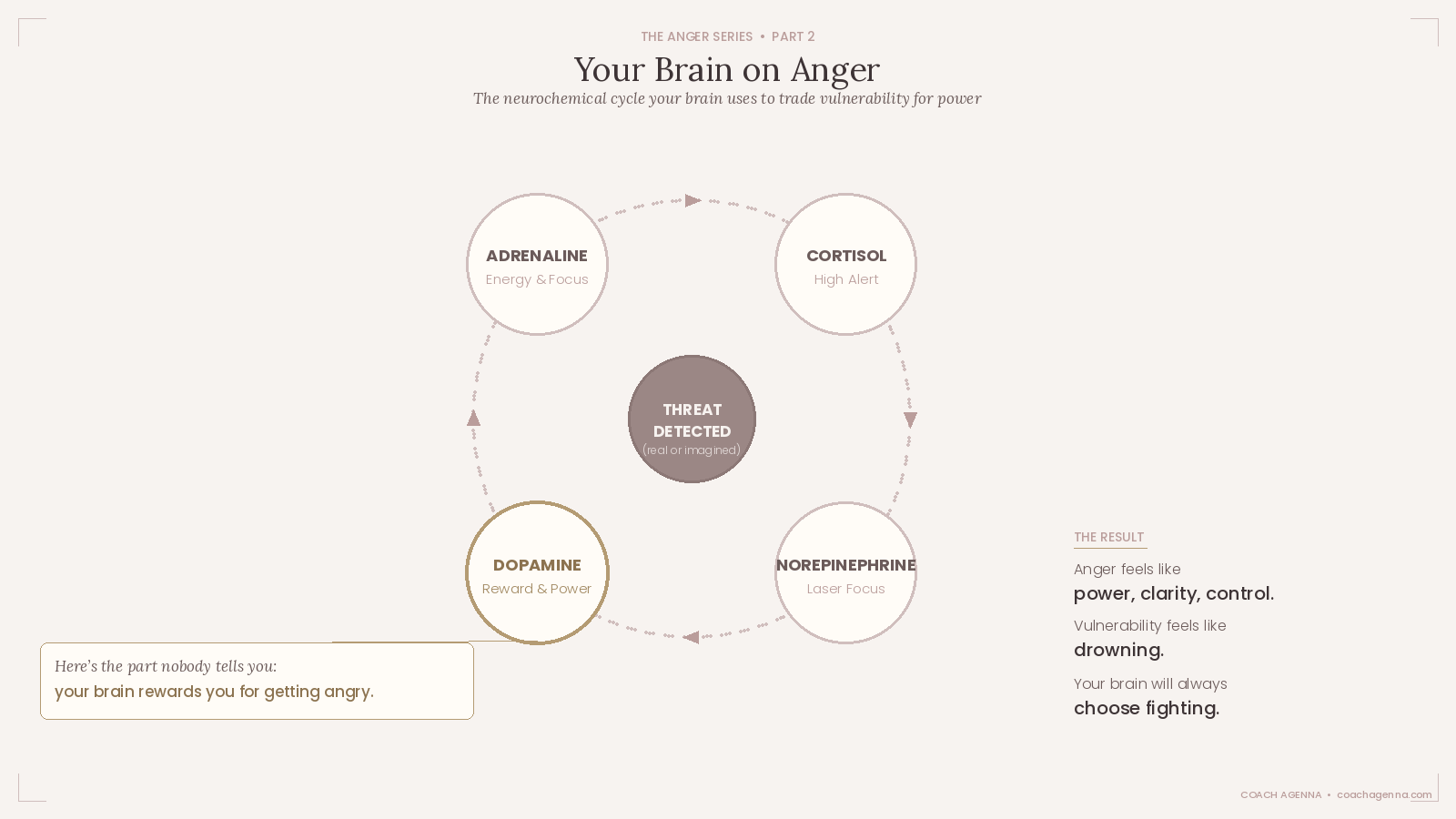
Part 2: Your brain rewards anger with dopamine, trading vulnerability for force.
Part 3: Your inner critic triggers the shame that fuels the anger cycle.
Part 4: The anger cycle is driven by identity — when losing feels like dying.
Part 5: Psychology names the pattern. Faith provides an identity that doesn’t need a bodyguard.
None of these posts are about eliminating anger. Anger is human. It’s neurological. God designed the system. The goal isn’t to never feel angry. The goal is to become a person whose anger doesn’t run the show. A person with enough capacity to feel the real feeling, name it, and choose what comes next.
That person isn’t built in five blog posts. They’re built in daily practice, in honest relationships, in the slow work of healing, and in the quiet belief that your worth was settled before you ever had to defend it.
If this series has stirred something in you and you’re ready to do the deeper work, coaching is the next step.
Book a free discovery call at coachagenna.com.
You shouldn’t have to earn your worth in every room you walk into. With coaching, you won’t.
If you’re healing from trauma and want to do it privately, on your own terms, my book can help:
Healing What Hides in the Shadows: A Private Journey Through Sexual Trauma Recovery
Available on Amazon. healingwhathidesintheshadows.com
Want to go deeper with this series?
Download the free Anger Series Companion Guide — five weeks of journaling prompts, exercises, and awareness practices that walk you through everything the bodyguard is protecting.
THE ANGER SERIES — COMPLETE
Part 1: Anger Is the Bodyguard, Not the Boss
Part 2: Why Does Anger Feel So Good?
Part 3: Your Inner Critic and Anger
Part 4: Why Do I Keep Going Back to Anger?
Part 5: What Does the Bible Say About Anger? ← You are here
FAQ
Q: What does the Bible say about anger? A: The Bible acknowledges anger as a human experience, not inherently sinful. Ephesians 4:26 says “In your anger do not sin,” assuming anger will happen. Psalm 103:8 describes God as “slow to anger.” The biblical framework focuses on what you do with anger, not whether you feel it.
Q: Is anger a sin according to the Bible? A: Anger itself is not a sin. Ephesians 4:26 specifically distinguishes between feeling anger and sinning in anger. Even God is described as experiencing anger. The sin is in letting anger control your actions, harden into bitterness, or drive you to harm others.
Q: What does ‘be angry and do not sin’ mean? A: This verse from Ephesians 4:26 means anger is expected and human, but it should not drive your decisions or behavior. Feel the anger, name it, but don’t hand it control over your words, relationships, or choices. The second half warns against letting anger persist into bitterness.
Q: How does faith help with anger? A: Faith offers an identity that isn’t built on performance, approval, or control — things that trigger anger when threatened. When your sense of worth is rooted in something that can’t be earned or lost, your brain stops treating every challenge as a survival event, reducing the anger response.

Recent Comments