
Rumination is not a thinking problem. It is a nervous system strategy. When your mind replays a conversation for the hundredth time, rehearses a conflict that hasn’t happened yet, or spirals through every possible outcome of a situation — your brain isn’t failing you. It’s protecting you.
The Rumination Roadmap is a trauma-informed, neuroscience-based framework developed by Coach Agenna to help people decode, interrupt, and rewire the repetitive thought patterns that keep them stuck. It is built on a simple but powerful premise: you cannot think your way out of rumination, because the thinking brain is partially offline when rumination is active. You need a different strategy.
Why Your Brain Gets Stuck in Loops
To understand rumination, you need to understand what’s happening in the brain when it occurs.
Neuroimaging research shows that during rumination, the brain’s default mode network (DMN) becomes overactive, the amygdala — your brain’s threat detection center — stays activated, and the prefrontal cortex — responsible for reasoning, perspective, and decision-making — becomes less effective (Hamilton et al., 2011; Nolen-Hoeksema et al., 2008).
In plain language: the part of your brain that could step back and say “this isn’t helpful” is dimmed. The part that scans for threats is running at full power. This is why telling yourself to “just stop thinking about it” almost never works. The off-switch is temporarily offline.
Rumination is not a sign of weakness, overthinking, or a lack of discipline. It is a protective circuit — your brain’s attempt to prevent emotional injury by rehearsing, scanning, and predicting. It was designed to keep you safe. The problem is that the circuit doesn’t know the original threat is over.
What Rumination Is Actually Trying to Do
This is the part most people miss: rumination has a purpose. Your brain is not repeating thoughts at random. It is returning to something unresolved.
Trauma researchers, including Judith Herman and Peter Levine, have shown that the brain stores unresolved emotional experiences as implicit memory — memory that lives in the body and nervous system rather than in narrative form. When something in your current life resembles a past emotional danger, your brain re-enters the nervous system state associated with it.
This explains why rumination feels urgent even when nothing urgent is happening. It feels relational even when you’re alone. It feels impossible to stop even when you know it isn’t logical. You’re not revisiting the event — you’re re-entering the emotional state connected to it.
As I tell my clients: your brain is not stuck in the past. It’s trying to finish something.
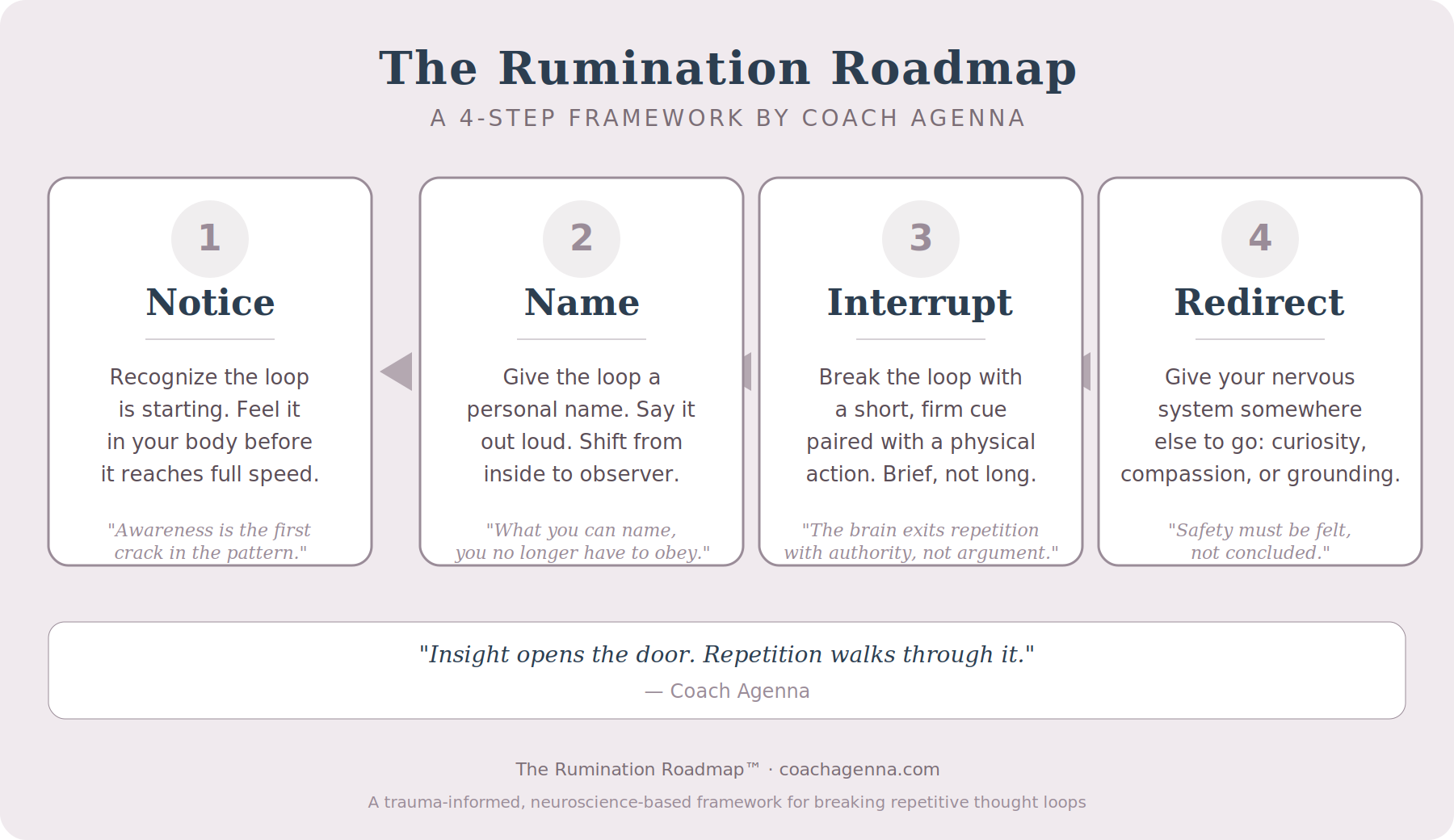
The Rumination Roadmap: 4 Steps
The Rumination Roadmap is a practical, repeatable process that works with your nervous system instead of against it. It is not about suppression or positive thinking. It is about giving your brain a new pathway to follow.
Step 1: Notice
Recognize that the loop has started.
Before you can change a pattern, you have to catch it. The first step is learning to recognize the physical and emotional signals that a rumination loop is activating — before it reaches full speed.
Common signals include: a tightening in the chest or stomach, a sense of urgency without a clear cause, a sudden need to mentally replay or rehearse, difficulty focusing on what’s in front of you, and a feeling that something is unresolved or “not right.”
The goal at this stage is not to stop the loop. It is simply to see it happening. Awareness is the first crack in the pattern.
Step 2: Name
Give the loop a specific, personal name.
This step is grounded in the neuroscience of affect labeling. Research by Lieberman et al. (2007) demonstrated that putting words to emotional experiences measurably reduces amygdala activation and increases prefrontal cortex regulation. Psychiatrist Daniel Siegel calls this principle “name it to tame it.”
When you give your thought loop a name — not a clinical label, but a name that feels true to your experience — you shift from being inside the thought to observing it. That shift is neurologically enormous.
Examples of loop names my clients have used: The Mental Courtroom. The Replay Machine. The Self-Correction Loop. The Outcome Projector. The Explanation Engine. The Relationship Scan. The What-If Generator.
The next time the loop starts, your job is to say the name — out loud if possible. Not to stop it. Not to fix it. Just to see it. What you can name, you no longer have to obey.
Step 3: Interrupt
Break the loop with a short, decisive cue — not a long argument.
Rumination is a procedural loop, not a logical one. Long reasoning gives it more fuel. What works is a brief, authoritative interruption — a short phrase paired with a physical action that signals your nervous system to shift.
This is supported by nervous system research, including Stephen Porges’ polyvagal theory, which shows that the brain exits threat-based loops when it receives clear safety and authority signals — not when it receives more information to process.
Effective interrupt cues are short and firm: “Enough.” “Stand down.” “Pause.” “I’m here.” Pair the phrase with a physical anchor: standing up, a hand gesture, changing location, splashing cold water on your face. The combination of verbal and physical interruption recruits the brainstem-to-cortex pathway, which is faster and more powerful than reasoning alone.
The brain exits repetition when it senses authority, not argument.
Step 4: Redirect
Give your nervous system somewhere else to go.
You cannot force an emotion to stop by arguing with it. Your nervous system does not respond to debate. But you can offer it a competing state — one that is genuine, not forced.
This is supported by emotion regulation research (Gross, 2015), which shows that you cannot suppress emotion effectively (it rebounds), but you can change emotional trajectory by introducing a different state. Curiosity, compassion, and grounding are the three states most effective at downshifting fear circuits.
Curiosity: Ask with genuine interest, not analysis. “What is actually happening right now — in this moment, in my body?” “What does this loop actually need from me?”
Compassion: Speak to yourself the way you would speak to someone you love. “This part of me is working very hard to keep me safe.” “I do not have to solve this right now.”
Grounding: Bring your awareness into the present moment. Slow exhale — make the out-breath longer than the in-breath. Name five things you can physically see. Feel your feet on the floor.
The goal is not distraction. The goal is resolution. You are not pretending to feel better. You are giving your nervous system a second option.
Why This Works: The Neuroplasticity Principle
Your brain has practiced its rumination loop thousands of times. That is why it feels automatic — because it is. But automatic does not mean permanent.
Every time you catch the loop, name it, interrupt it, and redirect — you are building a new neural pathway. Neuroplasticity research (Doidge, 2007; Siegel) confirms that repeated responses reshape neural pathways. What is practiced becomes preferred. Old loops weaken through disuse.
At first, the new response will feel effortful, like taking an unfamiliar route. With repetition, the new route becomes easier and the old one fades. This is not a one-time breakthrough. It is a practice — one response at a time.
As I remind my clients: insight opens the door. Repetition walks through it.
The Complete Sequence
Here is the full Rumination Roadmap in practice:
| Step | What You Do |
| 1. Notice | The loop is starting. I feel it in my body — chest tightening, urgency rising, focus narrowing. |
| 2. Name | “There’s the Replay Machine” (or your personal loop name). |
| 3. Interrupt | “Enough.” + stand up, change location, or use a physical anchor. |
| 4. Redirect | Curiosity, compassion, or grounding — whichever your nervous system responds to most. |
Progress is not measured by whether the loop appeared. It is measured by what you did next.
Common Types of Rumination
Not all rumination looks the same. Understanding your specific style helps you catch it faster and respond more effectively.
Replay rumination: Reviewing events as if watching footage — replaying conversations, analyzing what was said, what you should have said, what they meant by that look.
Rehearsal rumination: Scripting future conversations, preparing for conflicts that may never happen, trying to control outcomes by thinking through every scenario.
Analytical rumination: Dissecting tone, wording, and timing. Searching for the “right” explanation. Trying to figure out what someone really meant.
Self-correction rumination: An endless internal loop of evaluating your own behavior, finding it inadequate, and mentally revising it. Often connected to perfectionism and shame.
Relationship rumination: Monitoring the status of relationships — scanning for signs of disconnection, rejection, or abandonment. Research by Mikulincer and Shaver (2007) shows this often reflects attachment vigilance rather than insecurity. The brain learned that closeness required constant monitoring to stay safe.
What Rumination Is Not
Understanding what rumination is not helps set accurate expectations for healing:
- It is not a character flaw. Rumination is a nervous system strategy, not a personality defect.
- It is not “overthinking.” That label minimizes what is actually a threat-based survival response.
- It is not solved by positive thinking. Positive affirmations are processed in the reasoning brain, which is less active during rumination. You cannot knock on a door where nobody is home.
- It is not a sign of weak faith. Rumination reflects adaptation, not a lack of trust. Faith does not bypass the nervous system — it works through it.
- It is not permanent. The same neuroplasticity that wired the loop can rewire it.
Frequently Asked Questions
Why can’t I just stop ruminating if I know it’s not helpful?
Because rumination is driven by your threat detection system, not your reasoning system. Neuroimaging research shows that during rumination, the prefrontal cortex — the part of your brain that could say “this isn’t helpful” — is less active. The amygdala, which detects threats, stays activated. You cannot think your way out of a pattern that has taken your thinking brain partially offline. You need a different strategy — which is what the Rumination Roadmap provides.
How is the Rumination Roadmap different from mindfulness?
Mindfulness and the Rumination Roadmap share some principles — particularly the emphasis on awareness and naming. The difference is that the Roadmap is a structured, step-by-step response sequence designed specifically for trauma-based thought loops. It includes active interruption and redirection, not just observation. For people whose rumination is rooted in trauma, passive observation alone can sometimes intensify the loop rather than breaking it.
How long does it take for the new pattern to replace the old one?
There is no fixed timeline. Some people notice a shift within days of beginning the practice. For most, meaningful change develops over weeks of consistent use. The key is not perfection but repetition — every time you complete the sequence, even imperfectly, you are strengthening a new neural pathway. The old loop weakens through disuse, not force.
Can I use the Rumination Roadmap on my own, or do I need a coach?
You can start practicing the four steps on your own. Many people find that simply naming their loop creates immediate relief. However, working with a trauma-informed coach can accelerate the process — especially in identifying which loops are trauma-based patterns, developing personalized interrupt cues, and building accountability for consistent practice.
What if the rumination is about a real problem that needs solving?
There is a difference between productive problem-solving and rumination. Problem-solving moves toward a solution. Rumination circles without resolution. If you’re unsure which you’re doing, ask yourself: “Am I getting closer to an answer, or am I covering the same ground again?” If it’s the same ground, the Roadmap applies. Address the loop first, then return to the problem with your full brain online.
Does this work for relationship rumination — overthinking about how people feel about me?
Yes. Relationship rumination is one of the most common patterns I work with. Research shows that this type of overthinking often reflects attachment vigilance — a nervous system that learned closeness required constant monitoring. The Roadmap helps you recognize when your brain is scanning for relational threats that aren’t present, interrupt the cycle, and redirect toward grounding instead of more analysis.
The Core Truth About Rumination
Rumination is not a cognitive failure. It is a nervous system strategy rooted in memory, attachment, and threat detection. Healing occurs not through thinking harder, but through naming, interrupting, and completing the emotional signals the brain is trying to resolve.
Your brain is not broken. It detected something unresolved and launched a protection protocol. You are not overthinking. Your nervous system is doing its job. The Rumination Roadmap teaches it a new one.
You shouldn’t have to spend your life trapped in thought loops that were never yours to carry. With the right tools and the right guide, you won’t.
Recent Comments